`getProfile`, `documentList` and `memoryForget` all declare `required: []`,
so a model may legitimately call them with no arguments at all. The OpenAI
API serialises that as `arguments: ""`, and `parseToolArguments` handed the
empty string straight to `JSON.parse`, so every no-argument call came back as

    {"success":false,"error":"Invalid JSON arguments for getProfile"}

Those three tools were unreachable in their documented no-argument form.

The same gate also lets non-object JSON through. `"null"` parses cleanly and
then rejects in the destructuring parameter of every tool function --
`TypeError: Cannot destructure property 'containerTag' of 'object null'` --
which escapes `executeToolCall`, since it has no catch, and fails the whole
request. That is precisely the throw #1488 added this gate to contain. `"5"`
and `"\"text\""` are quieter but worse: they destructure to `undefined` and
call the API with no container tag at all.

Treat blank arguments as `{}`, and require the parsed value to be a non-null,
non-array object. Malformed JSON still returns the tool error #1488 added.

Adds eight regression tests. Six of them fail against the current
implementation -- two on the blank-argument path and four on the non-object
path, one carrying the raw TypeError. The two guard tests, malformed JSON and
an ordinary well-formed call, pass both before and after, so the behaviour
Three places where ClaudeMemoryTool diverges from the documented
memory_20250818 wire format:

- rename sends old_path/new_path, not path. handleCommand validated
  command.path, so every rename coming from a real model died with
  "Cannot read properties of undefined (reading 'startsWith')".
  path is still accepted as the source for existing callers.
- insert_line means "insert after this line" (0 = top of file), but we
  spliced at insertLine - 1 and rejected 0, so every insert landed one
  line above where Claude asked and inserting at the top was impossible.
- str_replace with new_str omitted is a deletion per the spec; we
  rejected it.

The new tests mock the supermemory client so they run without an API
key. Also fixed the rename example in the docs, which showed the same
path shape the code expected.
Anthropic's memory_20250818 spec defines insert as: insert_text is inserted
AFTER line insert_line, 0 inserts at the beginning of the file, and the valid
range is [0, n_lines]. The implementation treated insert_line as a 1-based
insert-BEFORE index with range [1, n_lines + 1].

Since the caller of this tool is Claude itself, which is trained on the spec
semantics, every model-driven insert landed one line earlier than intended,
insert_line: 0 (insert at top of file) was rejected as invalid, and
insert_line: n_lines (append) inserted before the last line instead of after
it.

Fix the validation range to [0, n_lines], splice at insert_line directly
(0-based insert-after), and update the error and success messages to match.
One existing tool-operations test encoded the old insert-before behavior; its
insert_line is adjusted so its expected output is unchanged under spec
semantics. Adds four regression tests covering top-of-file, middle,
append, and both out-of-range directions.
#1665 renamed getDocument, listSpaces, listDocuments, listMemories and whoAmI to snake_case with no aliases. Clients with a cached tool list (ChatGPT, Codex, Claude) still call the old names and fail 100% of the time (~2k errors from ~300 users in the last 10 days, per PostHog). The old names are now registered again with the same handler and a "Deprecated alias" description. They stay listed because ChatGPT rejects calls to tools missing from tools/list.
New shared snippet with the npx supermemory@latest migrate command, placed on the tools 3.0 guide, the four integration pages, the API reference overview and namespaces page, the ten migration sub pages, and the agents page. The migration guide keeps the command first and folds the paste-in prompt into an accordion; the --prompt variant is gone from the examples.
The Copy prompt button on the docs home still handed agents the v3/v4 prompt with containerTag and /v3/documents, and the hero code samples used the old call shape. Both now match the console's v5 onboarding prompt and the shipped SDKs, with install hints for the stable 5.x releases and a pointer to the migration guide. The agents page starter prompt drops the rc.5 { namespace, body } description.
Docs for supermemoryai/mono#3420: `GET /namespaces` returns `{namespaces, pagination}` (newest first, `limit` up to 100), and the SDK note now describes `namespaces.list()` and both delete outcomes (`status: "deleted"` / `"queued"`) correctly. Also rewrites the memory GET and batch-result descriptions so they no longer refer to other endpoints.
Rewrites 339 TypeScript calls across 50 pages from the rc.5 `method({ namespace, body })` form to the shipped `method(namespace, { ... })` form, and aligns field names with the live v5 spec: `attach` to `include`, `authUrl` to `authorization`, `lastSync` to `latestRun`, `deletedCount` to `count`, and the paginated `namespaces.list()`.

Renames container tags to namespaces across concepts, connectors, integrations and snippets. The namespace pages keep container tag in the description, search keywords and a rename note so old searches still land, and the v3 reference page points at v5.

The migration guide's SDK table now covers both 5.0.0 SDKs, and the SDK integration page uses the real client options (`baseUrl`, `timeoutInSeconds`, `maxRetries`) and error classes.
Docs for supermemoryai/mono#3421: ingest `taskType`/`dreaming` move into the JSON body (form fields on file routes, alongside `fileType`/`mimeType`); namespace delete takes `moveTo` as a query param and rejects a body. Adds a "where parameters live" rule to the migration overview.
Every integration (AI SDK, OpenAI, Mastra, VoltAgent, Claude memory) now calls v5 through `supermemory@5`. The config takes one `namespace` instead of `containerTags` or `projectId`, and `withSupermemory` takes `namespace` and `id` instead of `containerTag` and `customId`. No aliases. With no config the tools still use `sm_project_default`.

Conversations are stored as one document per conversation keyed by `id` instead of `/v4/conversations`. `memoryForget` drops `reason`; forgetting by text previews with `forgetMatching` and then forgets exact matches by id. Claude memory marks its files with `metadata.source` instead of a second tag. Search keeps the 2.x defaults so results do not shift.

`packages/ai-sdk` is removed: npm already deprecates it in favor of `@supermemory/tools/ai-sdk`, so its CI steps and playground wiring go too. `apps/sdk-playground` moves to the new tools API and v5 routes, including its Python server.

Tested against production: add, search, profile, list and delete. 112 unit tests pass; type errors drop from 148 to 141, none new. The `supermemory` dependency pins the rc until 5.0.0 is published.
Docs for supermemoryai/mono#3417: list pagination defaults (`page=1`, `limit=10`, max 100, `sort=createdAt`, `order=desc`) and `include.forgotten` for memory lists. Absorbs #1768.
Docs for supermemoryai/mono#3415: delete and batch return `count`; ingest `status` is `queued`/`done` (batch adds `error`, files say `queued`); document `system.status` values; search `isInference` and `included.document.system`; `metadata` never null.
Renames v5 `attach` to `include`. GET routes take one comma-separated `include` query param (`?include=chunks,memories`); search takes every option in the JSON body, with `include` as an object of booleans. Also fixes the `forgotten` description: it does let forgotten memories come back as primary results. Pairs with supermemoryai/mono#3410.
Document every migrated workflow, request and response change, typed-filter conversion, verification strategy, and rollout step so agents can upgrade integrations deterministically.
Add Legacy and Latest reference versions, organize the V5 operations by workflow, and introduce focused overview pages backed by the generated V5 OpenAPI document.
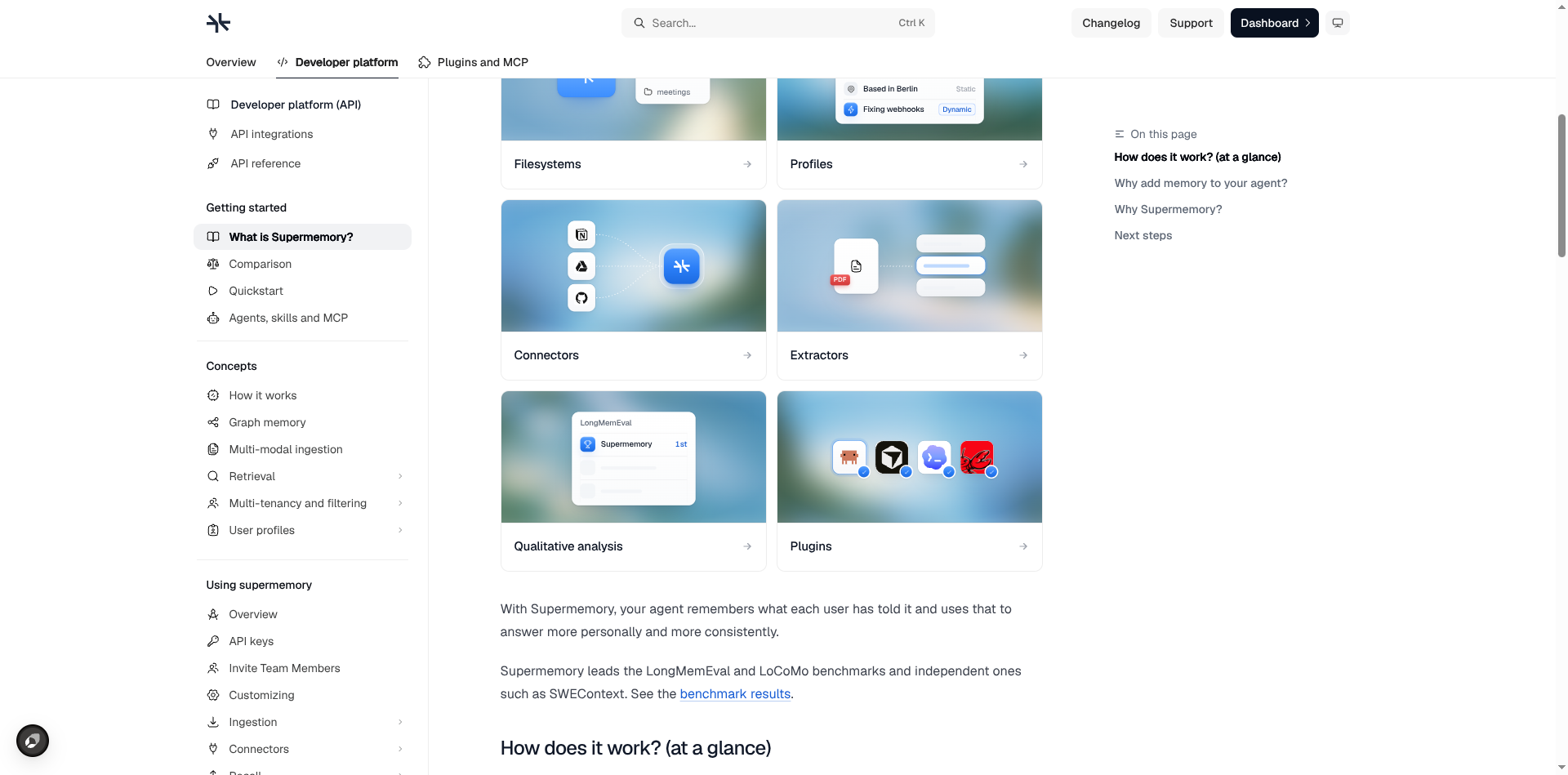
The overview page passed connector/plugin logo paths and card background paths through custom component props. Those dynamic `<img src={...}>` values bypass Mintlify's asset rewriting: the deployed `/docs` page requests `/images/...` from the main website and gets 404s, although the assets exist under `/docs/images/...`.
Declare all seven logos and the eight card background images directly in MDX, with `Tile` and `ArtTile` rendering children instead of dynamic image sources. Keep the existing layout, badges, background positioning, and mirrored artwork. Background images use `noZoom` to preserve the direct-child markup required by the existing blur styles.
Verified with `mintlify validate` and the local Mintlify preview: all seven logos load with HTTP 200 and the background artwork renders with its original blur. The production result still needs verification after Mintlify deploys the change.
<!-- capy-badge:start -->
<a href="https://capy.ai/thread/jam_01M44PHNNK05Y3SVB3NCKNWAXS"><picture><source media="(prefers-color-scheme: dark)" srcset="https://capy.ai/badge/accent-dark.svg"><source media="(prefers-color-scheme: light)" srcset="https://capy.ai/badge/accent-light.svg"><img alt="Open in Capy" src="https://capy.ai/badge/accent-light.svg"></picture></a>
<!-- capy-badge:end -->
- 402 now tells the agent the org is out of credits and links to console.supermemory.ai/billing (the old message said "memory limit" and pointed at the retired app).

- PostHog MCP analytics tags these calls `$mcp_error_type: out_of_credits` with `$mcp_is_error: false`, so an empty balance no longer inflates the MCP error rate.
The server is stateless HTTP, so every tool call landed in its own PostHog session. Enable conversation ids and let $mcp_conversation_id and $session_id through the metadata filter so echoed handles group calls.