 693ad49719
* Litellm ishaan march23 - MCP Toolsets + GCP Caching fix  (#25146)

* feat(mcp): MCP Toolsets — curated tool subsets from one or more MCP servers (#24335)

* feat(mcp): add LiteLLM_MCPToolsetTable and mcp_toolsets to ObjectPermissionTable

* feat(mcp): add prisma migration for MCPToolset table

* feat(mcp): add MCPToolset Python types

* feat(mcp): add toolset_db.py with CRUD helpers for MCPToolset

* feat(mcp): add toolset CRUD endpoints to mcp_management_endpoints

* fix(mcp): skip allow_all_keys servers when explicit mcp_servers permission is set (toolset scope fix)

* feat(mcp): add _apply_toolset_scope and toolset route handling in server.py

* fix(mcp): resolve toolset names in responses API before fetching tools

* feat(mcp): add mcp_toolsets field to LiteLLM_ObjectPermissionTable type

* feat(mcp): register LiteLLM_MCPToolsetTable in prisma client initialization

* feat(mcp): validate mcp_toolsets in key-vs-team permission check

* feat(mcp): register toolset routes in proxy_server.py

* feat(mcp): add MCPToolset and MCPToolsetTool TypeScript types

* feat(mcp): add fetchMCPToolsets, createMCPToolset, updateMCPToolset, deleteMCPToolset API functions

* feat(mcp): add useMCPToolsets React Query hook

* feat(mcp): add toolsets (purple) as third option type in MCPServerSelector

* feat(mcp): extract toolsets from combined MCP field in key form

* feat(mcp): extract toolsets from combined MCP field in team form

* feat(mcp): show toolsets section in MCPServerPermissions read view

* feat(mcp): pass mcp_toolsets through object_permissions_view

* feat(mcp): add MCPToolsetsTab component for creating and managing toolsets

* feat(mcp): add Toolsets tab to mcp_servers.tsx

* feat(mcp): pass mcpToolsets to playground chat and responses API calls

* feat(mcp): generate correct server_url for toolsets in playground API calls

* docs(mcp): add MCP Toolsets documentation

* docs(mcp): add mcp_toolsets to sidebar

* fix(mcp): replace x-mcp-toolset-id header with ContextVar to prevent client forgery

* fix(mcp): use ContextVar + StreamingResponse for toolset MCP routes (fixes SSE streaming)

* fix(mcp): cache toolset permission lookups to avoid per-request DB calls

* test(mcp): add tests for toolset scope enforcement, ContextVar isolation, and access control

* fix(mcp): cache toolset name lookups in MCPServerManager to avoid per-request DB calls

* fix(mcp): prevent body_iter deadlock + use cached toolset lookup in responses API

- _stream_mcp_asgi_response: add done callback to handler_task that puts
  the EOF sentinel on body_queue when the task exits, preventing body_iter
  from hanging forever if the handler raises after headers are sent.
- litellm_proxy_mcp_handler: replace raw get_mcp_toolset_by_name() DB call
  with global_mcp_server_manager.get_toolset_by_name_cached() so toolset
  resolution uses the 60s TTL cache added for this purpose instead of
  hitting the DB on every responses-API request.

* fix(mcp): toolset access control, asyncio fix, and real unit tests

- server.py: _apply_toolset_scope now enforces that non-admin keys must
  have the requested toolset_id in their mcp_toolsets grant list;
  admin keys always bypass the check.
- mcp_management_endpoints.py: three access-control fixes:
  * fetch_mcp_toolsets: non-admin keys with mcp_toolsets=None now
    return [] instead of all toolsets (only admins get 'all' when
    the field is absent)
  * fetch_mcp_toolset: non-admin keys that haven't been granted the
    requested toolset_id now get 403 instead of the full result
  * add_mcp_toolset: duplicate toolset_name now returns 409 Conflict
    instead of an opaque 500
- proxy_server.py: use asyncio.get_running_loop() instead of
  get_event_loop() inside an already-running coroutine (Python 3.10+).
- test_mcp_toolset_scope.py: replace four hollow tests that only
  asserted local variable properties with real tests that call the
  production fetch_mcp_toolsets() and handle_streamable_http_mcp()
  functions with mocked dependencies.

* fix(mcp): add mcp_toolsets to ObjectPermissionBase, fix multi-toolset overwrite, fix delete 404, allow standalone key toolsets

* fix(mcp): add auth check on toolset resolution in responses API; union mcp_servers in _merge_toolset_permissions

* fix(mcp): handle RecordNotFoundError in update_mcp_toolset; union direct servers with toolset servers

* fix(mcp): use _user_has_admin_view; deny None mcp_toolsets for non-admin; use direct RecordNotFoundError import; fix docstring

* fix(mcp): add @default(now()) to MCPToolsetTable.updated_at; fix test for non-admin toolset access

* fix: use UniqueViolationError import; guard _ensure_eof for error/cancel only

* fix(mcp): preserve mcp_access_groups in toolset scope, use shared Redis cache for toolset perms

- Remove mcp_access_groups=[] from _apply_toolset_scope (server.py) and the
  responses API toolset path (litellm_proxy_mcp_handler.py). A key's access-group
  grants remain valid even when the request is scoped to a single toolset; clearing
  them silently revoked legitimate entitlements.

- Switch resolve_toolset_tool_permissions and get_toolset_by_name_cached to use
  user_api_key_cache (Redis-backed DualCache in production) instead of per-instance
  in-memory dicts. Cache entries are now shared across workers, eliminating the
  per-worker stale-toolset-permission window flagged as a P1 by Greptile.

- Use union merge (set union of tool names per server) when applying toolset
  permissions in the responses API path so direct-server tool restrictions are not
  overwritten by toolset permissions.

* fix(mcp): return 404 when edit_mcp_toolset target does not exist

* fix(mcp): align mcp_toolsets default to None in LiteLLM_ObjectPermissionTable

* fix(mcp): admin toolset visibility, in-place tool name mutation, test helper coercion

* fix(mcp): treat None/[] team mcp_toolsets as no restriction in key validation

* fix(mcp): allow_all_keys backward compat, blocked_tools API write-path, efficient startup query

* fix(mcp): use _mcp_active_toolset_id ContextVar to detect toolset scope, avoiding DB-default false-positive

* fix(mcp): remove dead toolset cache stubs, log invalidation failures, align schema updated_at defaults

* fix(mcp): deserialise MCPToolset from Redis cache hit, replace fastapi import in test

* fix(mcp): evict name-cache on toolset mutation, 409 on rename conflict, warning-level list errors

* fix(redis): regenerate GCP IAM token per connection for async cluster (#24426)

* fix(redis): regenerate GCP IAM token per connection for async cluster clients

Async RedisCluster was generating the IAM token once at startup and
storing it as a static password. After the 1-hour GCP token TTL, any
new connection (including to newly-discovered cluster nodes) would fail
to authenticate.

Fix: introduce GCPIAMCredentialProvider that implements redis-py's
CredentialProvider protocol. It calls _generate_gcp_iam_access_token()
on every new connection, matching what the sync redis_connect_func
already does. async_redis.RedisCluster accepts a credential_provider
kwarg which is invoked per-connection.

* refactor(redis): move GCPIAMCredentialProvider to its own file

Extract GCPIAMCredentialProvider and _generate_gcp_iam_access_token
into litellm/_redis_credential_provider.py. _redis.py imports them
from there, keeping the public API unchanged.

* fix: address Greptile review issues

- GCPIAMCredentialProvider now inherits from redis.credentials.CredentialProvider
  so redis-py's async path calls get_credentials_async() properly
- move _redis_credential_provider import to top of _redis.py (PEP 8)
- remove dead else-branch that silently no-oped (gcp_service_account from
  redis_kwargs.get() was always None since it's popped by _get_redis_client_logic)
- remove mid-function 'from litellm import get_secret_str' inline import
- remove unused 'call' import from test_redis.py

* chore: retrigger CI/review

* chore: sync schema.prisma copies from root

* chore: sync schema.prisma copies from root

* fix(proxy_server): use bounded asyncio.Queue with maxsize to prevent unbounded growth

* fix(a2a/pydantic_ai): make api_base Optional to match base class signature

* fix(a2a/pydantic_ai): make api_base Optional in handler and guard against None

* fix(mcp): remove unused get_all_mcp_servers import

* fix(mcp): remove unused MCPToolset import

* refactor(mcp): extract toolset permission logic to reduce statement count below PLR0915 limit

* fix(tests): update reload_servers_from_database tests to mock prisma directly

---------

Co-authored-by: Ishaan Jaff <ishaanjaffer0324@gmail.com>
Co-authored-by: github-actions[bot] <41898282+github-actions[bot]@users.noreply.github.com>

* fix(toolset_db): lazy-import prisma to avoid ImportError when prisma not installed

* fix(tests): update UI tests for toolset tab and updated empty state text

* fix(tests): add get_mcp_server_by_name to fake_manager stub

---------

Co-authored-by: Ishaan Jaff <ishaanjaffer0324@gmail.com>
Co-authored-by: github-actions[bot] <41898282+github-actions[bot]@users.noreply.github.com>
9.3 KiB
import Tabs from '@theme/Tabs'; import TabItem from '@theme/TabItem';
MCP Toolsets
A Toolset is a named collection of specific tools drawn from one or more MCP servers. Instead of giving an agent access to every tool on every server, you pick exactly which tools it needs — from whichever servers they live on — and bundle them under a single name.
How it works
                    ┌─────────────────────────────────┐
                    │         MCP Toolset              │
                    │      "devtooling-prod"           │
                    └────────────┬────────────────────┘
                                 │
              ┌──────────────────┴──────────────────┐
              │                                     │
     ┌────────▼────────┐                  ┌────────▼────────┐
     │  CircleCI MCP   │                  │  DeepWiki MCP   │
     │  (10+ tools)    │                  │  (3 tools)      │
     └────────┬────────┘                  └────────┬────────┘
              │                                    │
    ┌─────────┴──────────┐              ┌──────────┴──────────┐
    │ ✓ get_build_logs   │              │ ✓ read_wiki_structure│
    │ ✓ find_flaky_tests │              │ ✓ read_wiki_contents │
    │ ✓ get_pipeline_    │              │ ✗ ask_question       │
    │   status           │              └─────────────────────┘
    │ ✓ run_pipeline     │
    │ ✗ list_followed_   │
    │   projects         │
    └────────────────────┘

        Agent sees exactly 6 tools, nothing more.
Instead of 13+ tools across two servers, the agent gets 6 — the ones it actually needs.
Why this matters:
- Smaller tool lists → fewer tokens, faster responses, less hallucination
- Combine tools from GitHub + Linear + CircleCI into one named grant
- Assign to keys and teams the same way you assign MCP servers today
Create a toolset
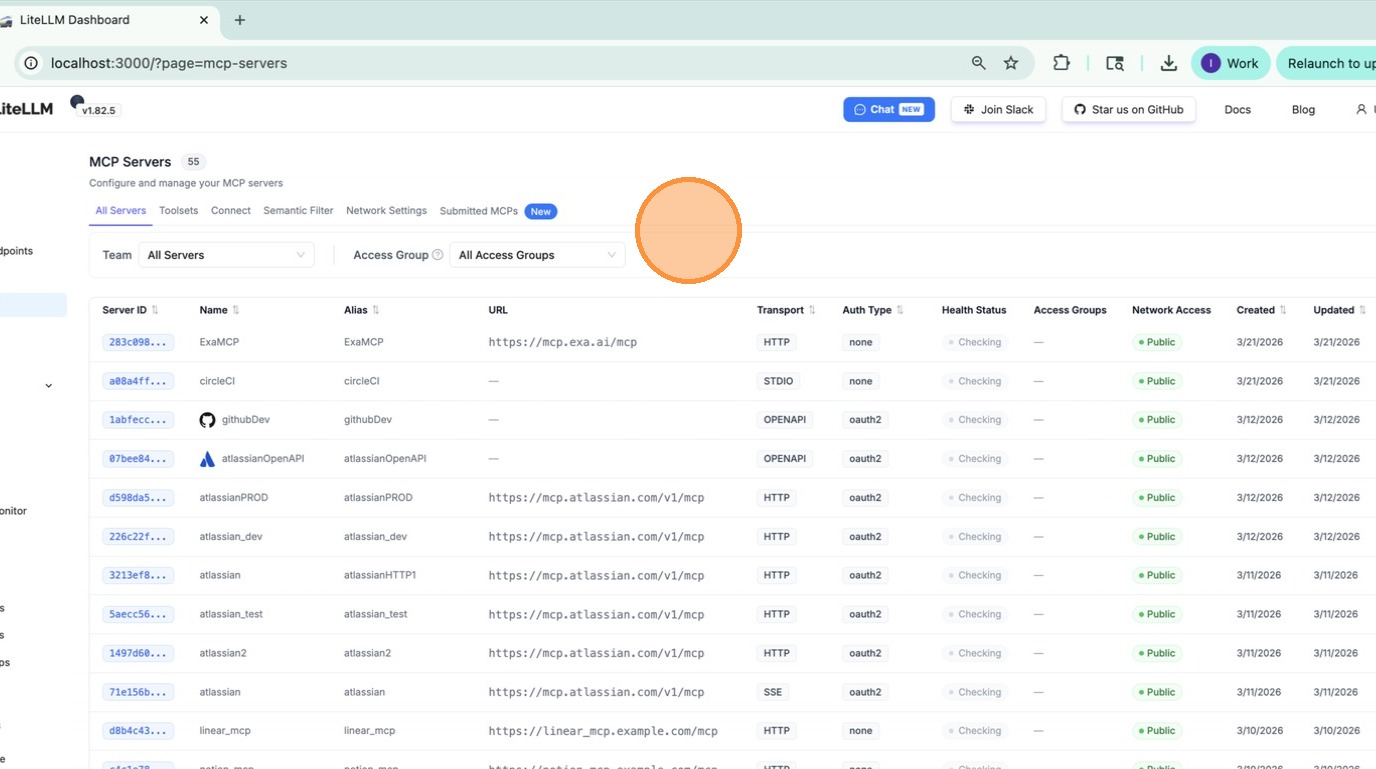
1. Go to the MCP page
Navigate to MCP in the left sidebar.
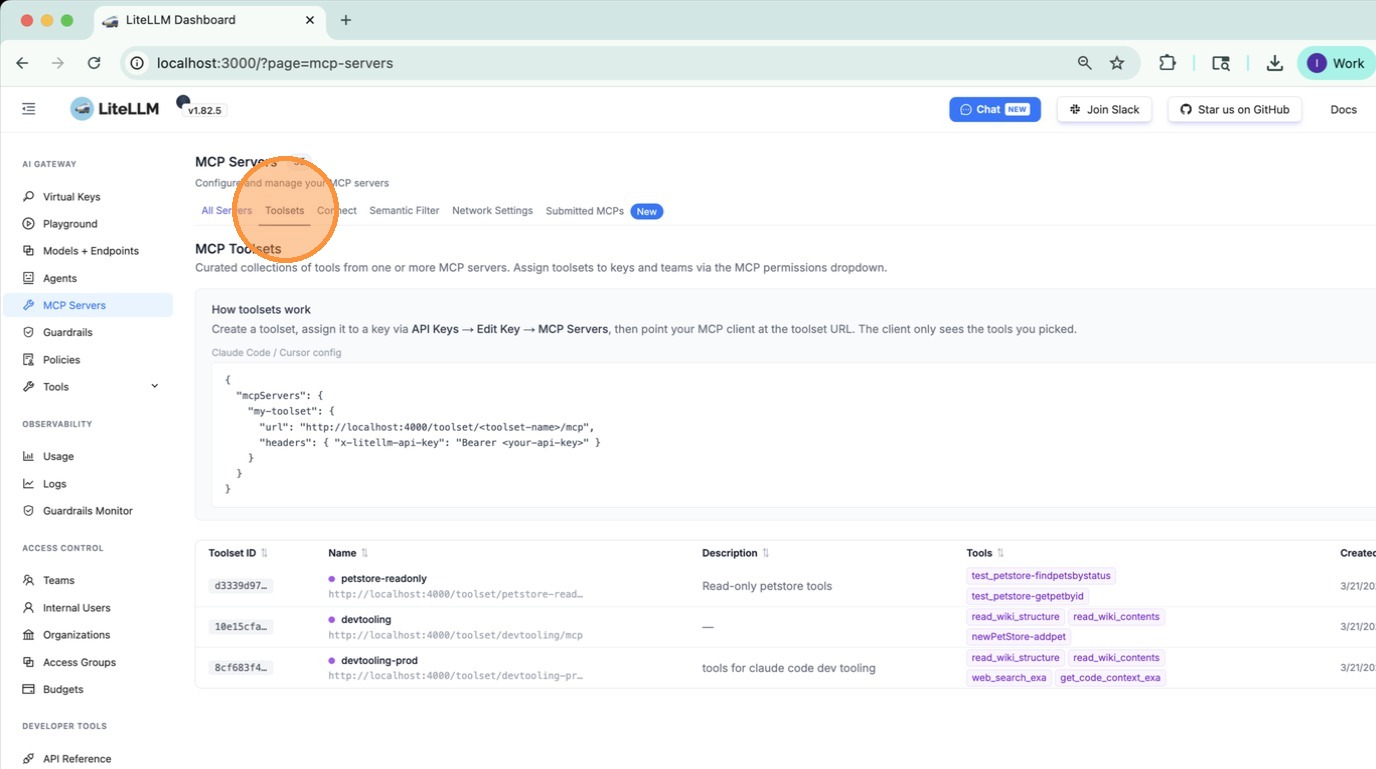
2. Open the Toolsets tab
Click the Toolsets tab on the MCP page.
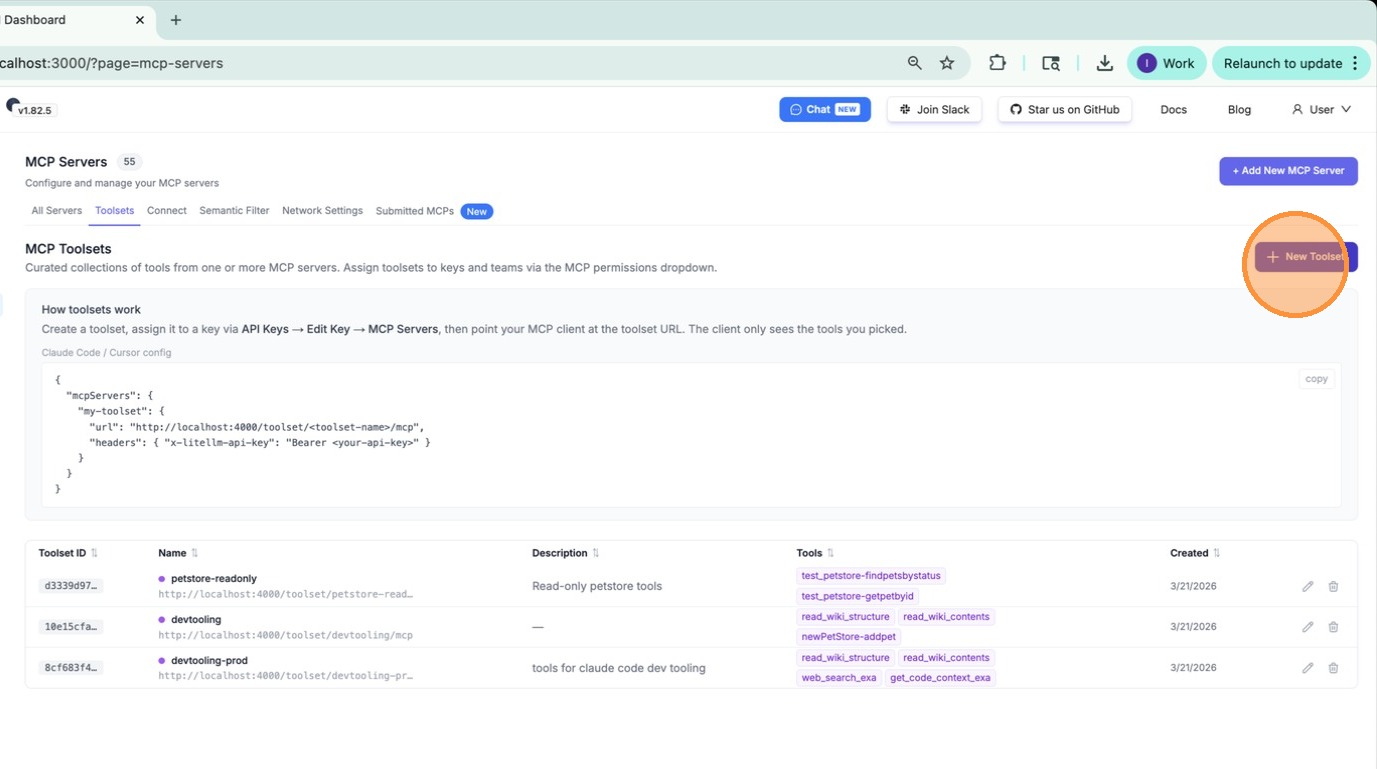
3. Click "New Toolset"
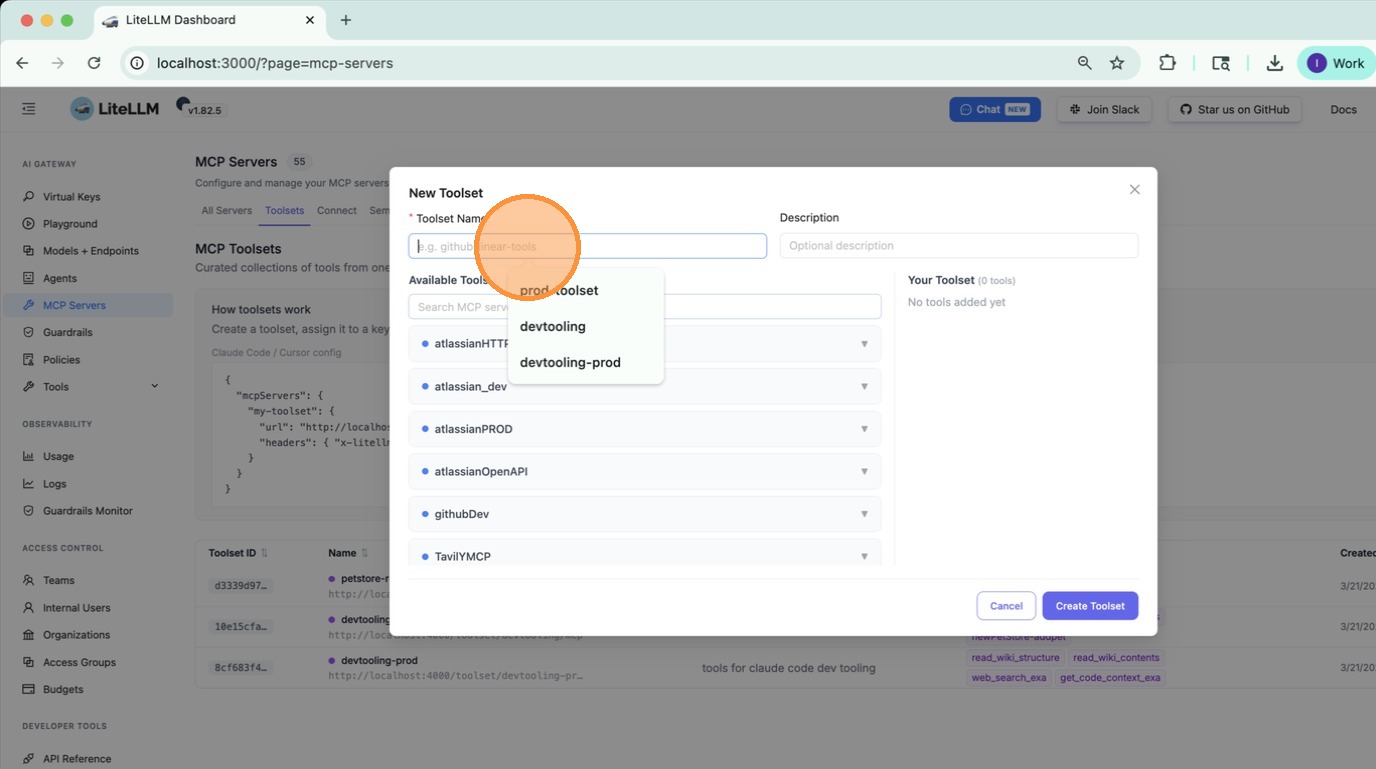
4. Enter a name
Type a name for the toolset. Pick something descriptive — this is what agents will reference.
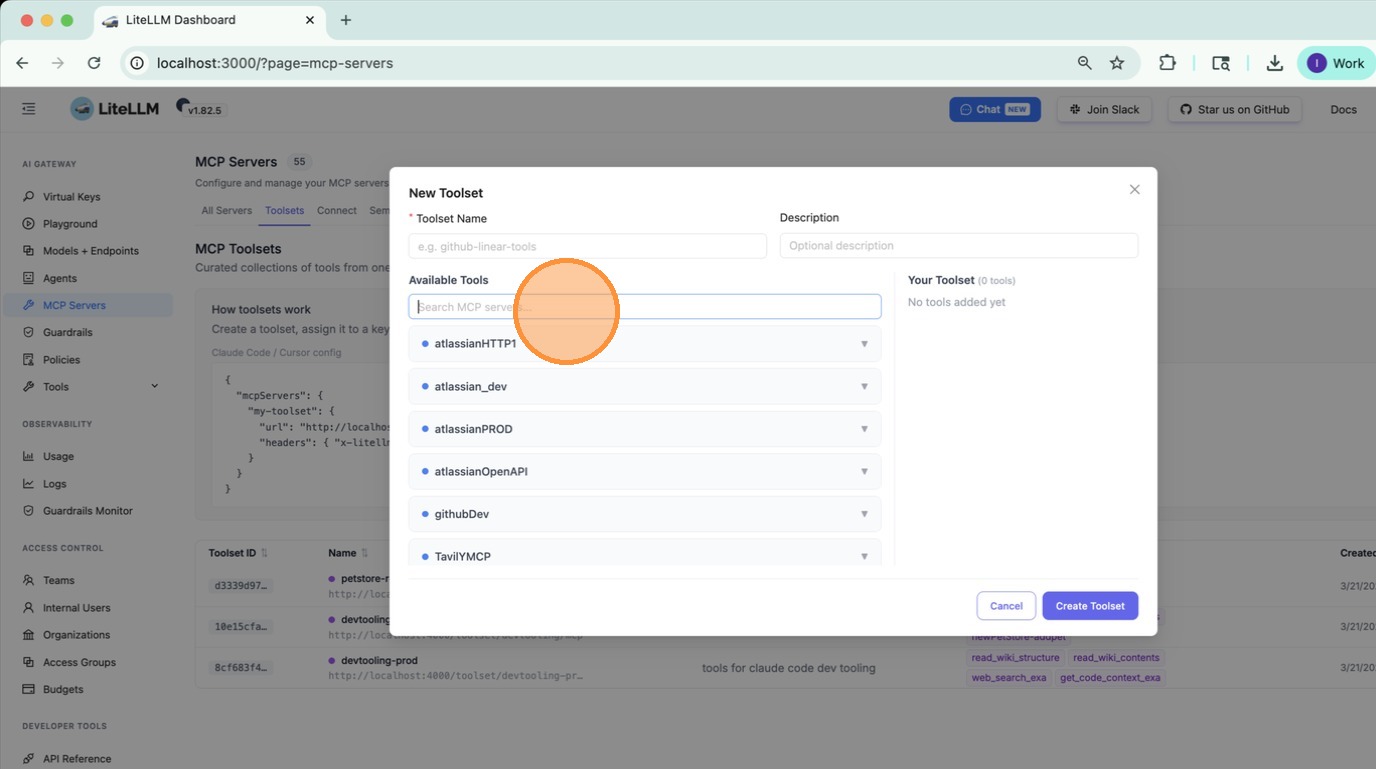
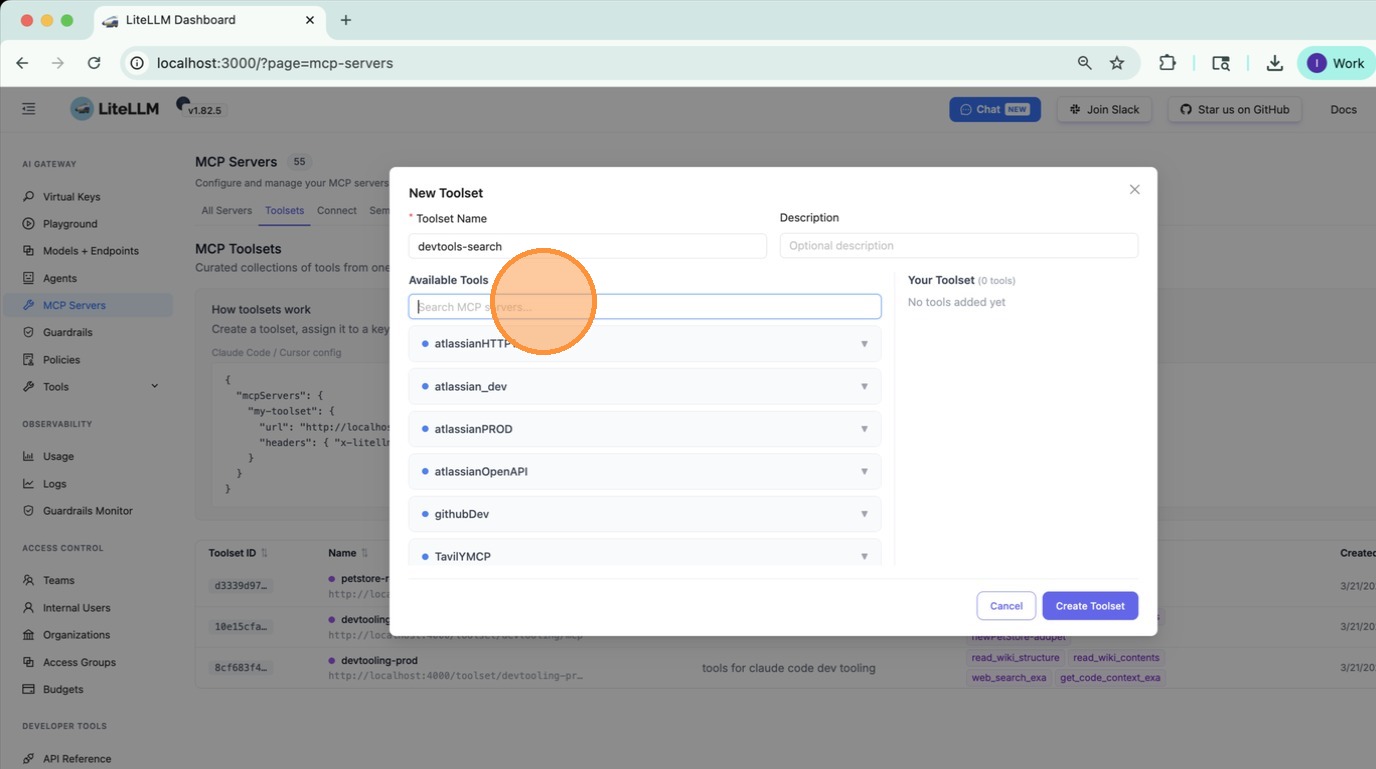
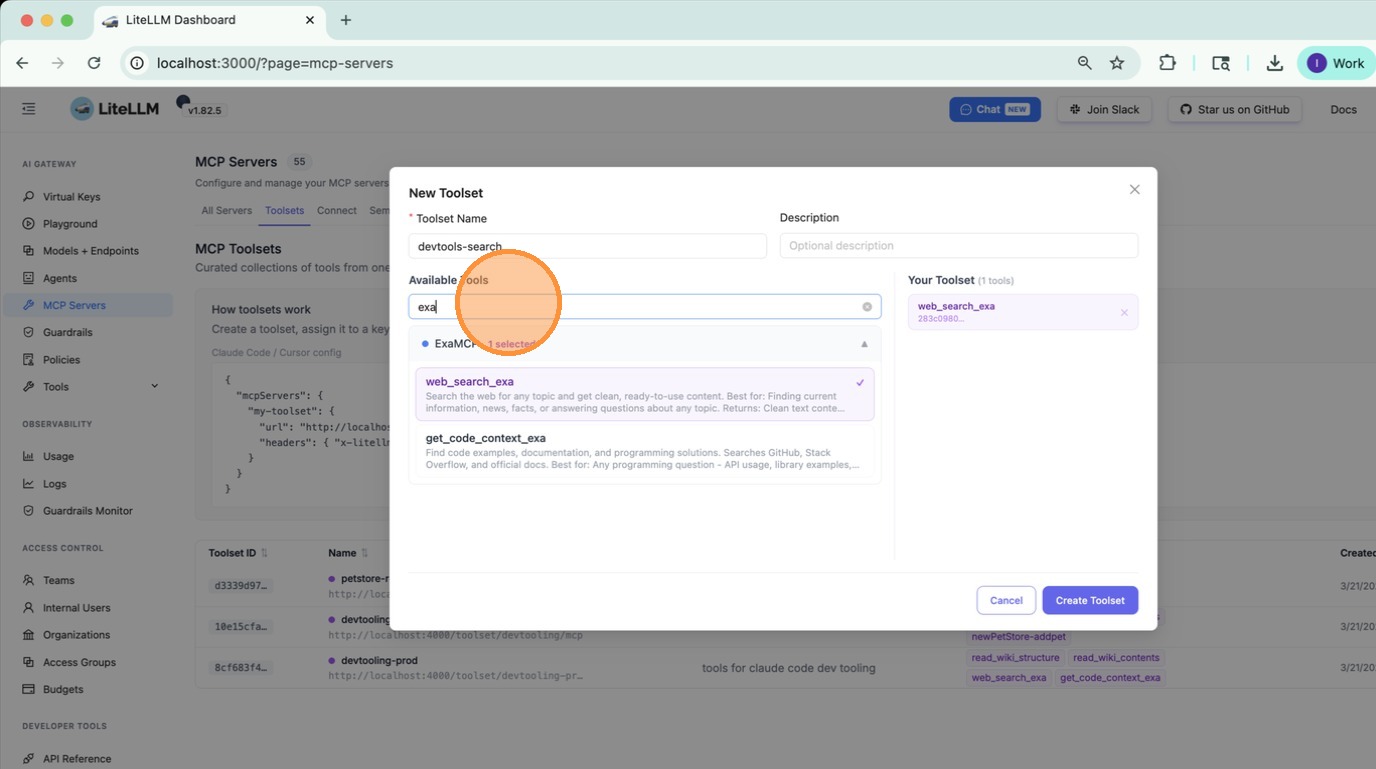
5. Add the first tool
Select an MCP server from the dropdown, then choose the tool you want to include from that server.
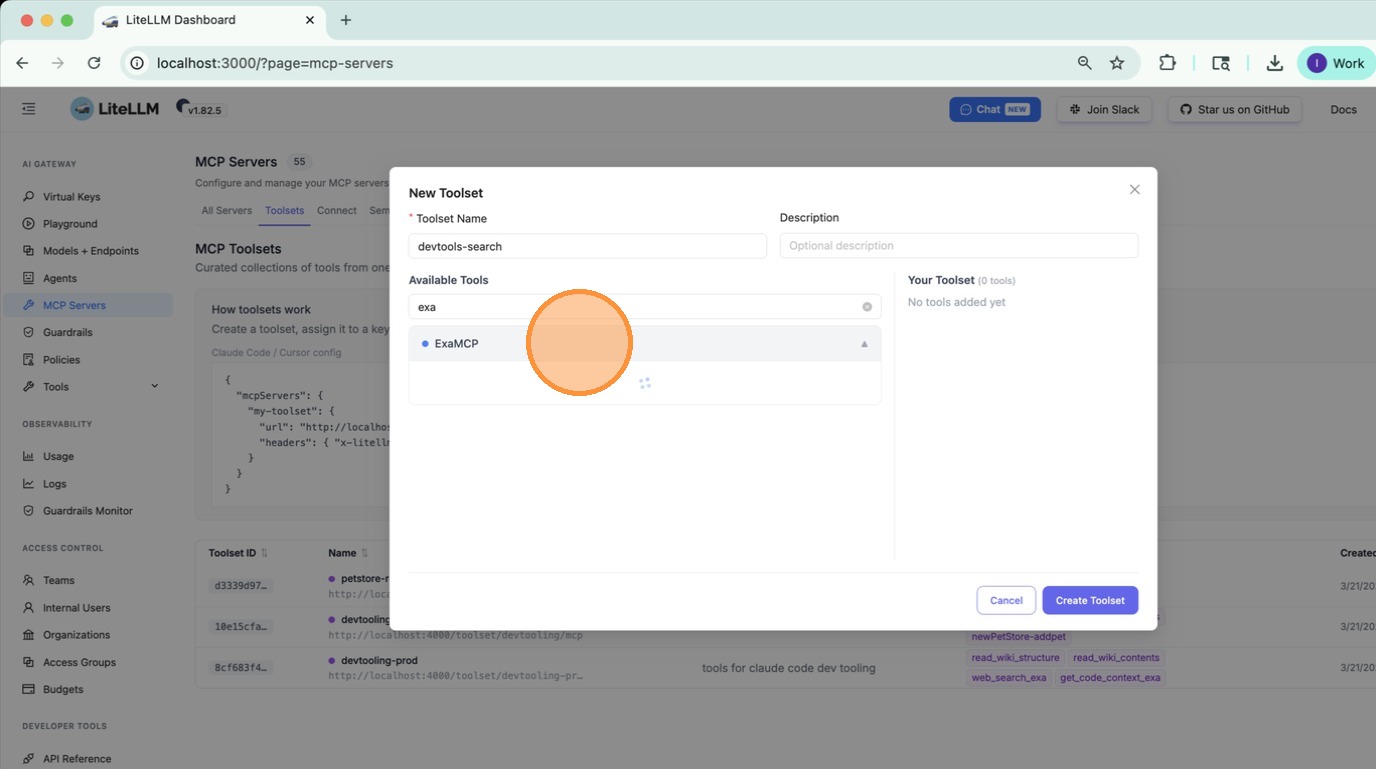
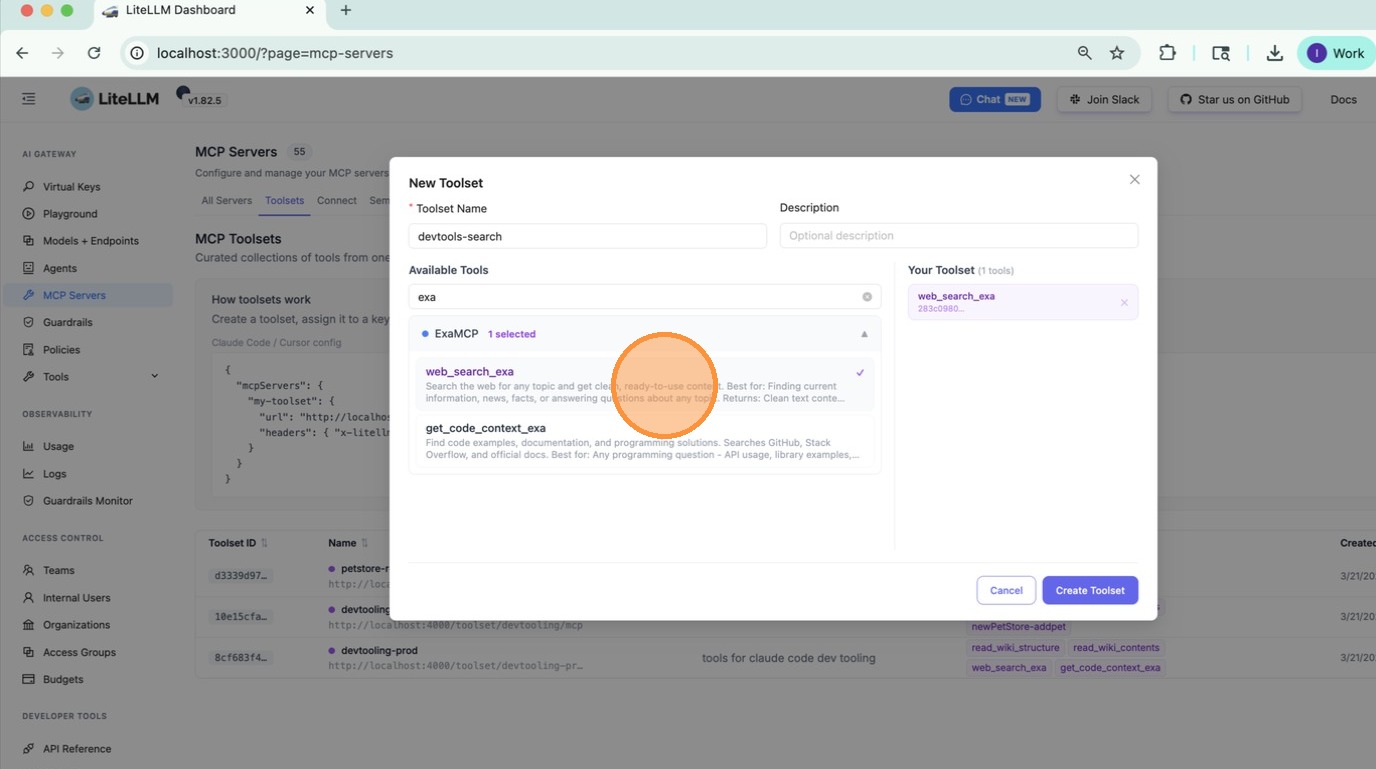
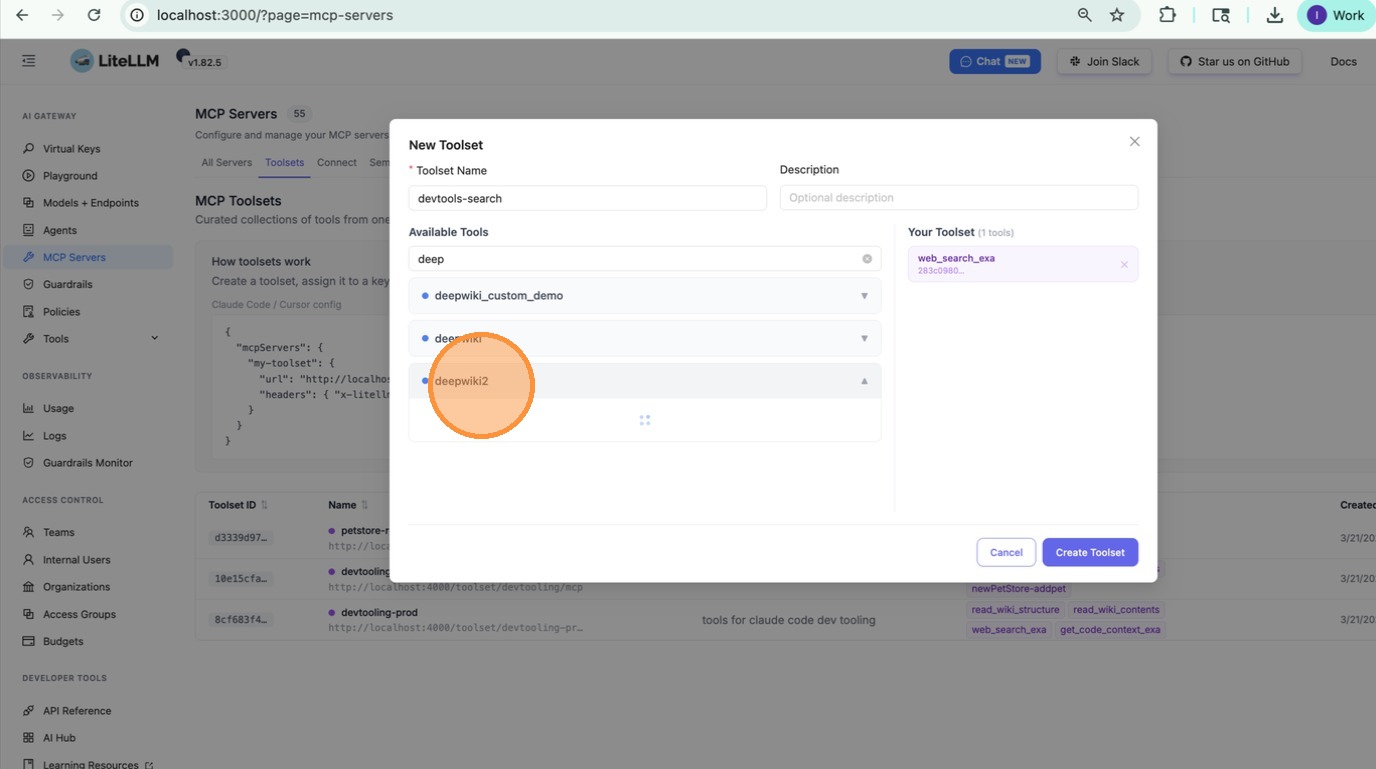
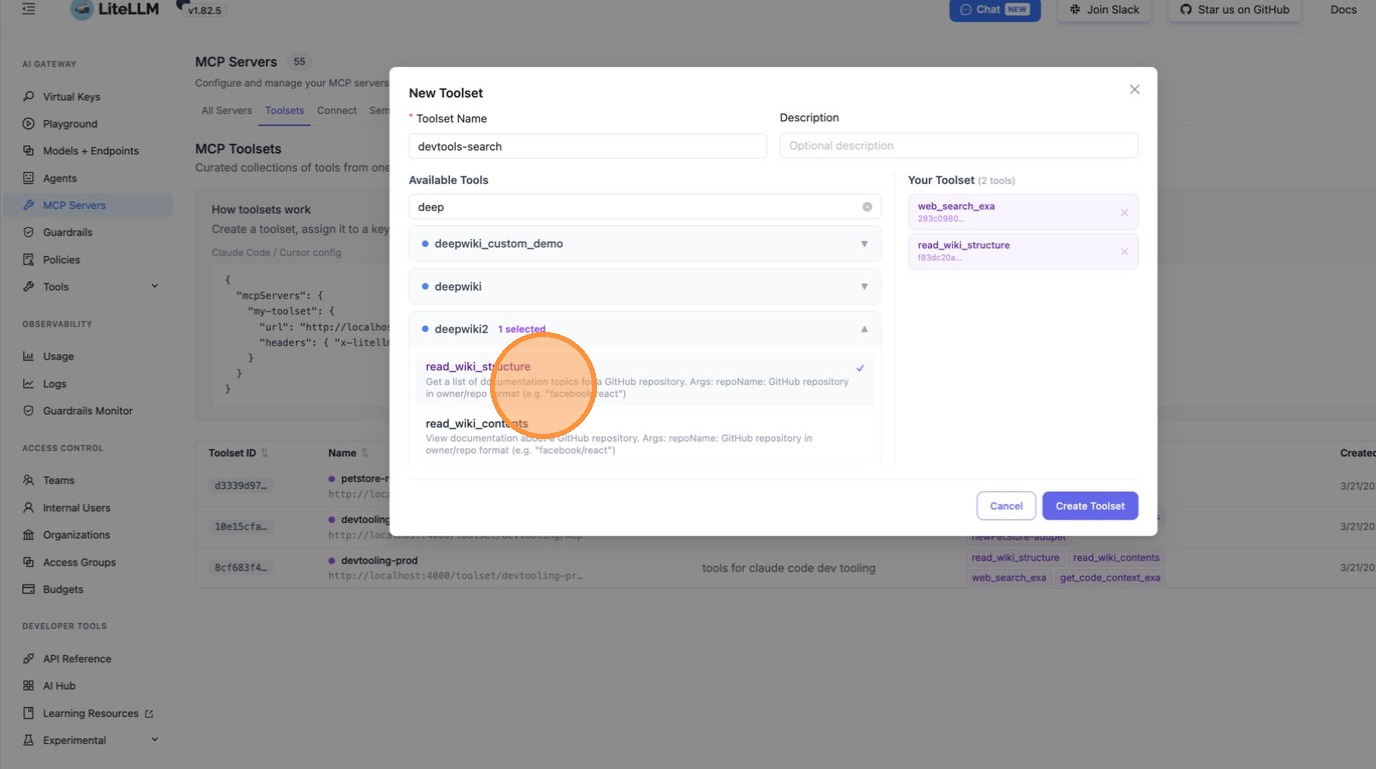
6. Add tools from a second server
Click Add Tool, pick a different MCP server, and select another tool. Repeat for as many tools as you need — they can come from any number of servers.
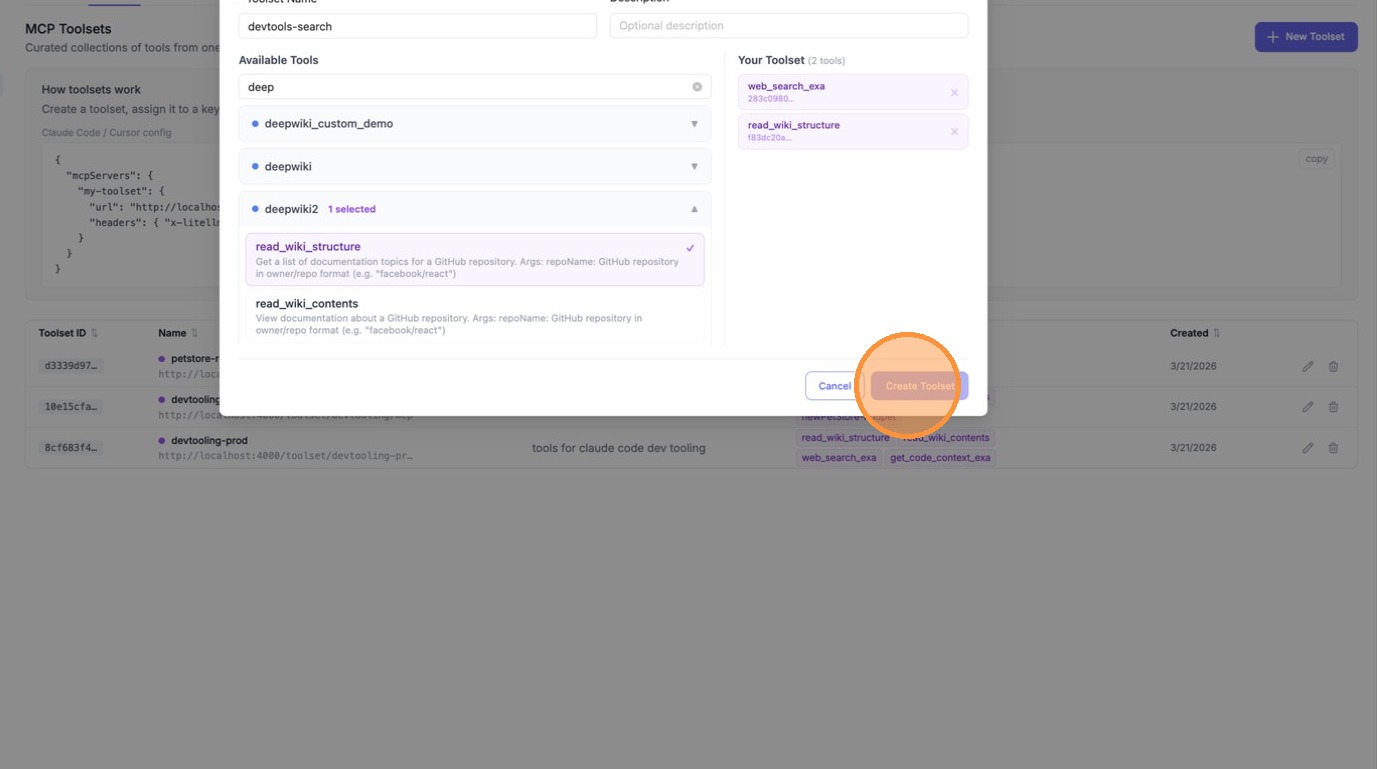
7. Create the toolset
Click Create Toolset to save.
Use a toolset in the Playground
Once created, your toolset appears alongside MCP servers in the MCP Servers dropdown in the Playground — it's selectable the same way.
1. Go to the Playground
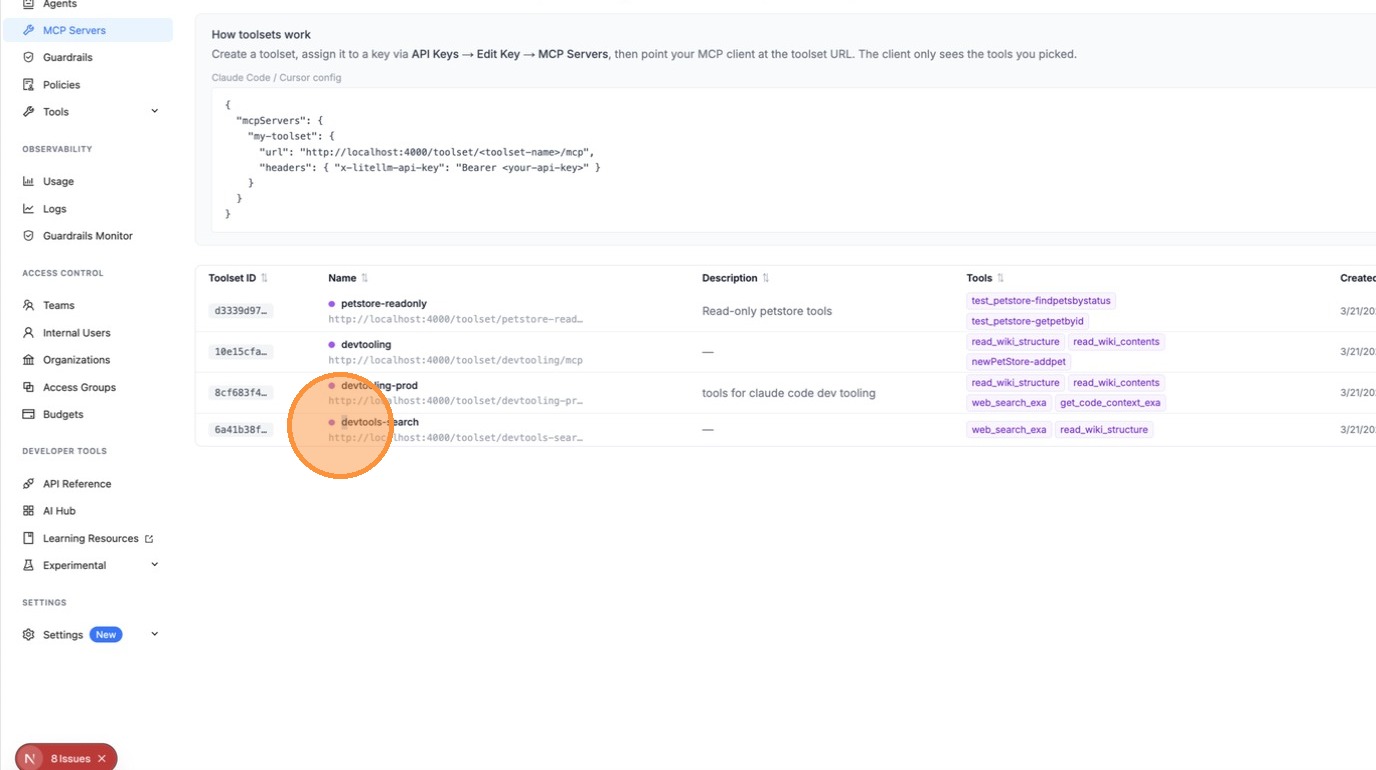
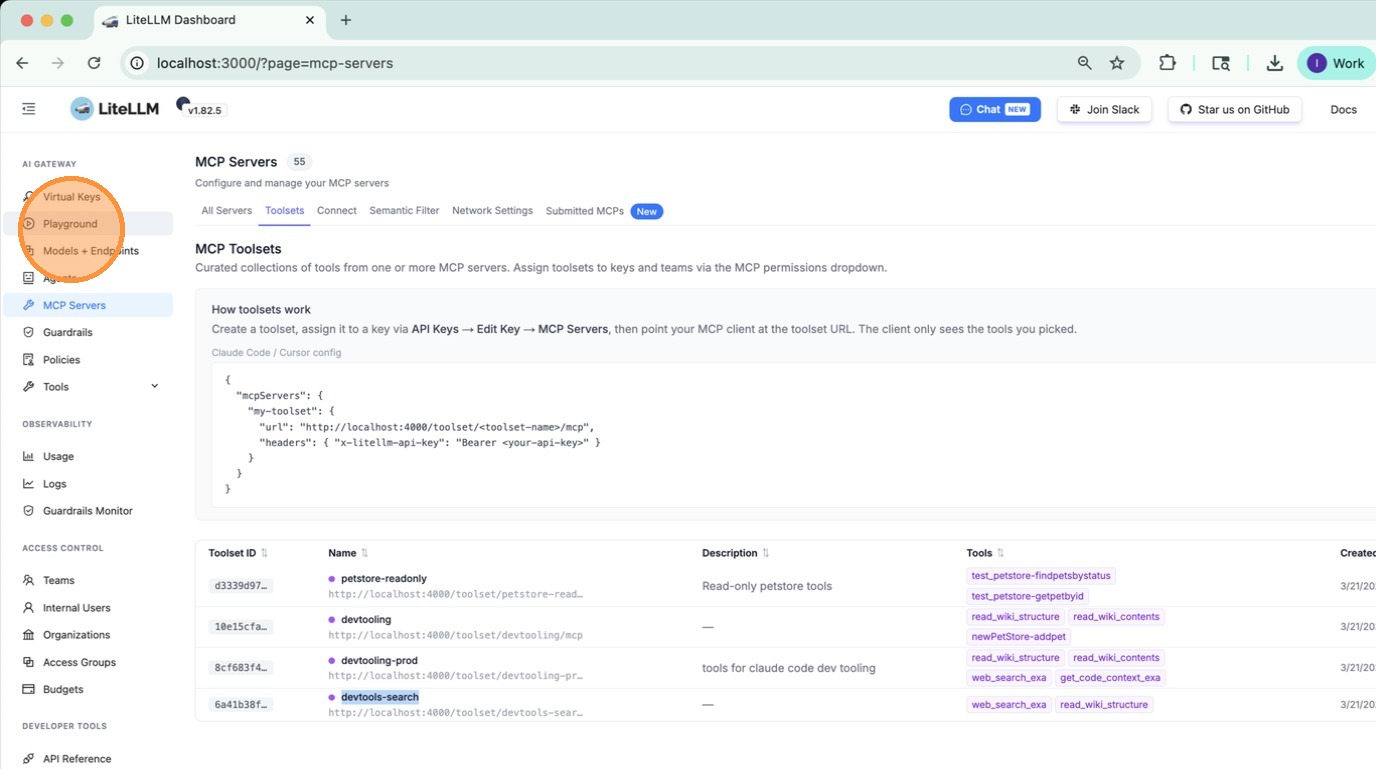
2. Select your toolset from MCP Servers
In the left panel under MCP Servers, open the dropdown and pick your toolset. The model will only see the tools you included in it.
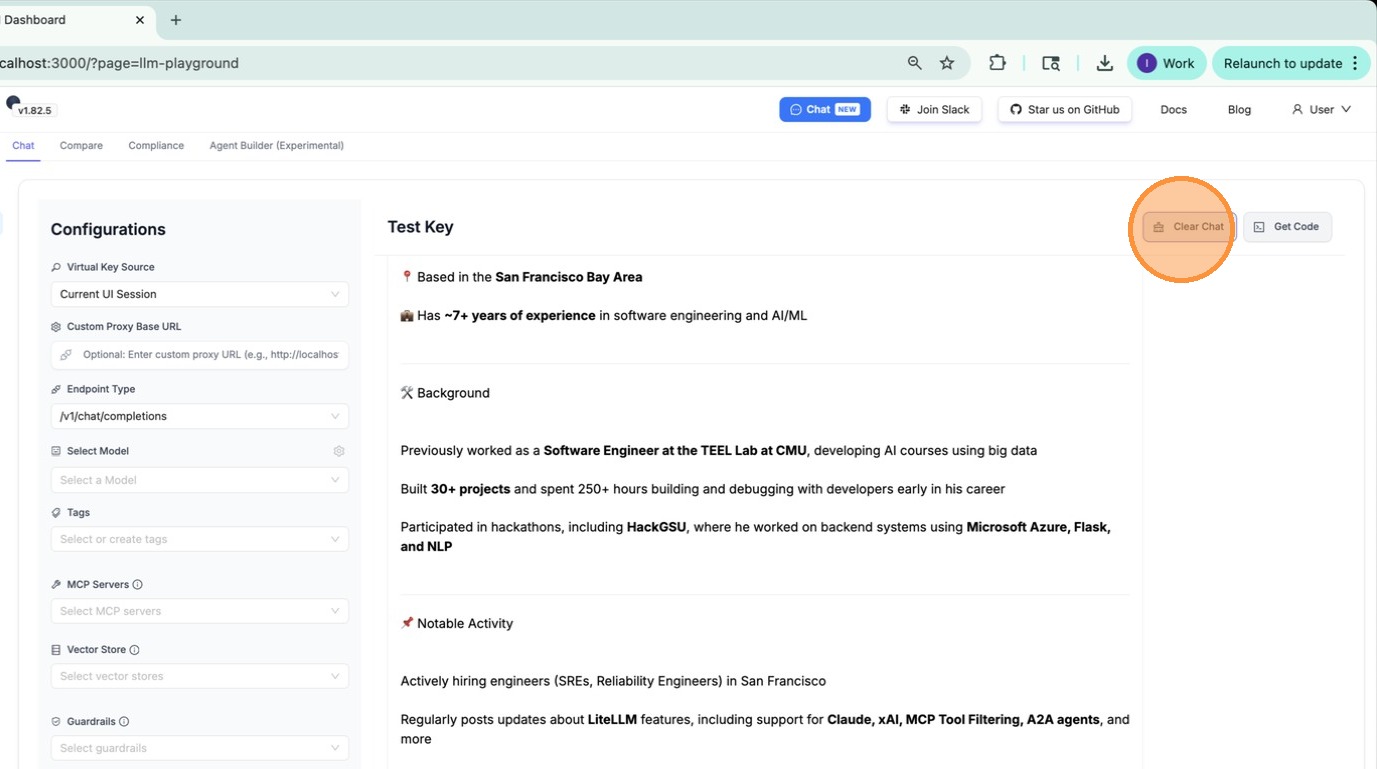
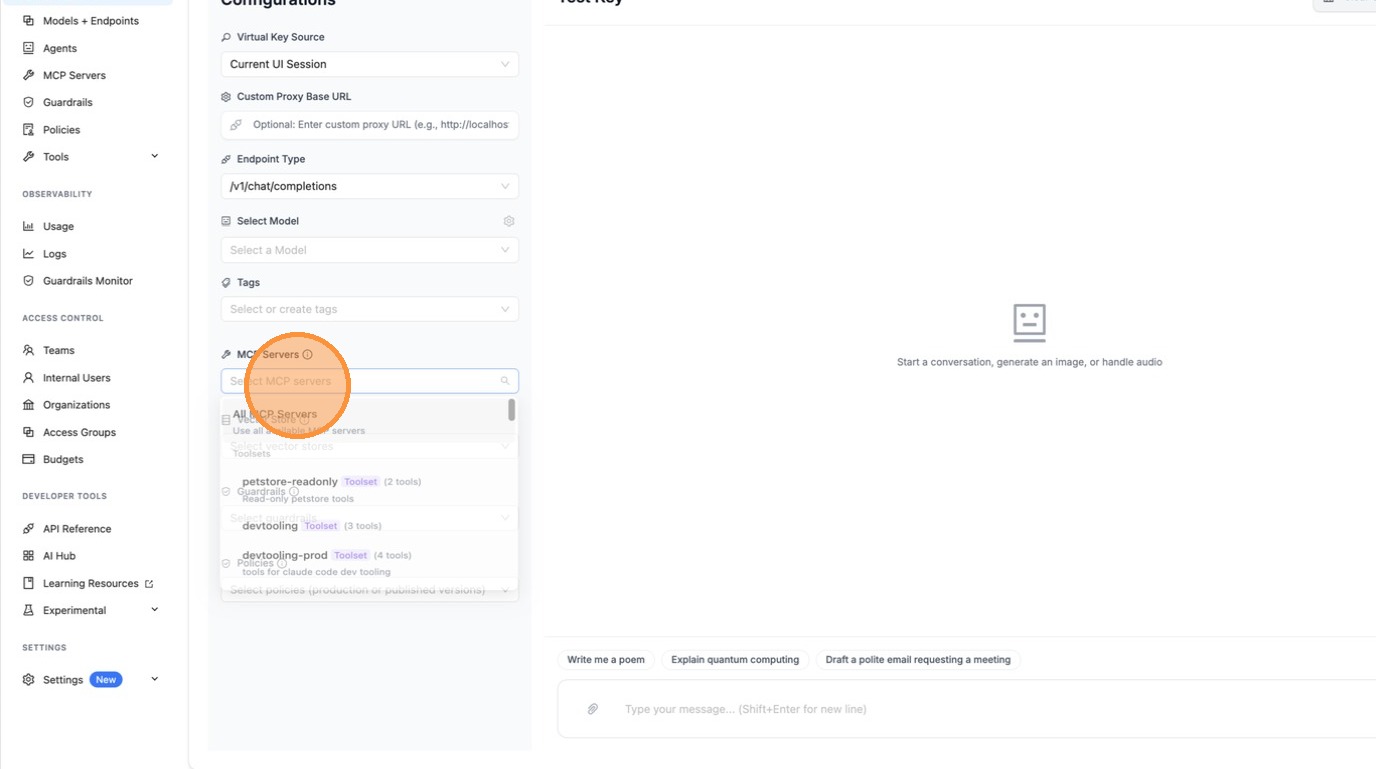
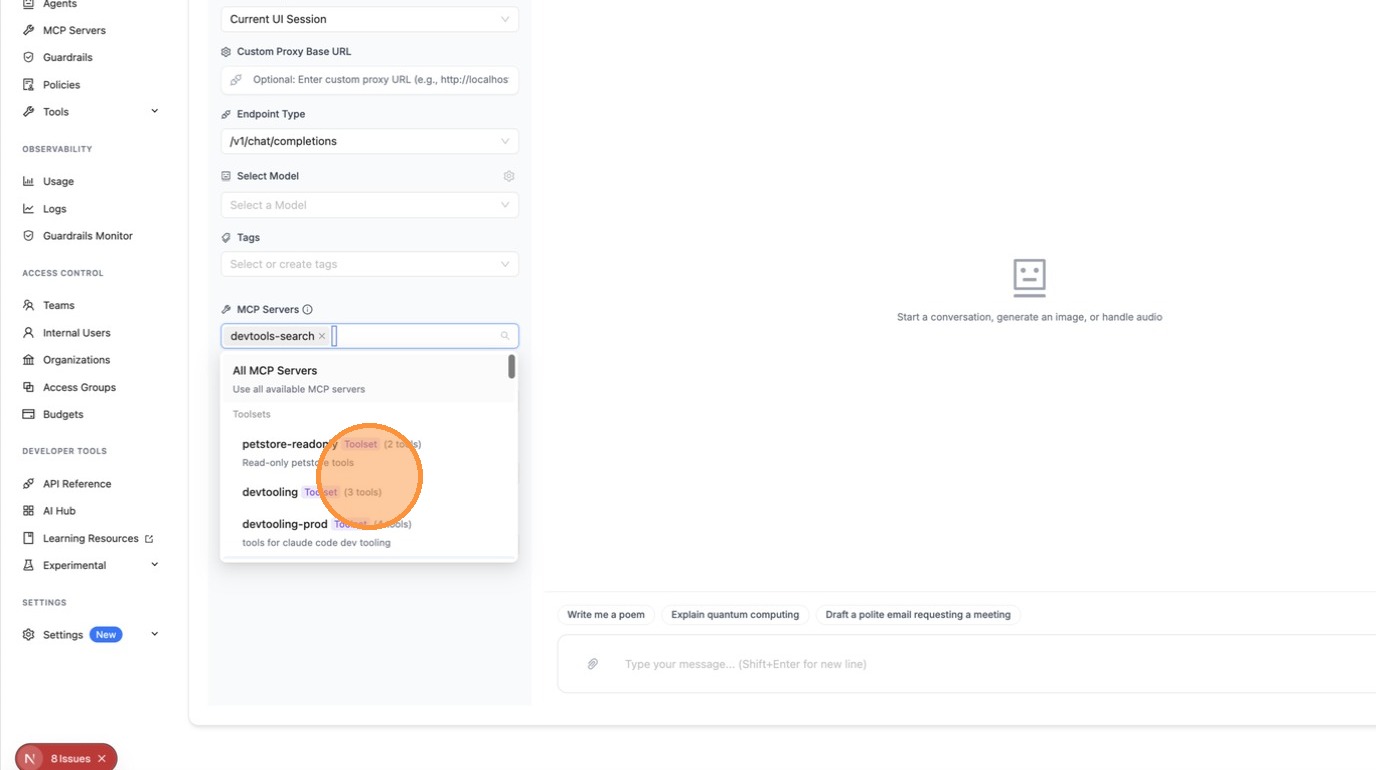
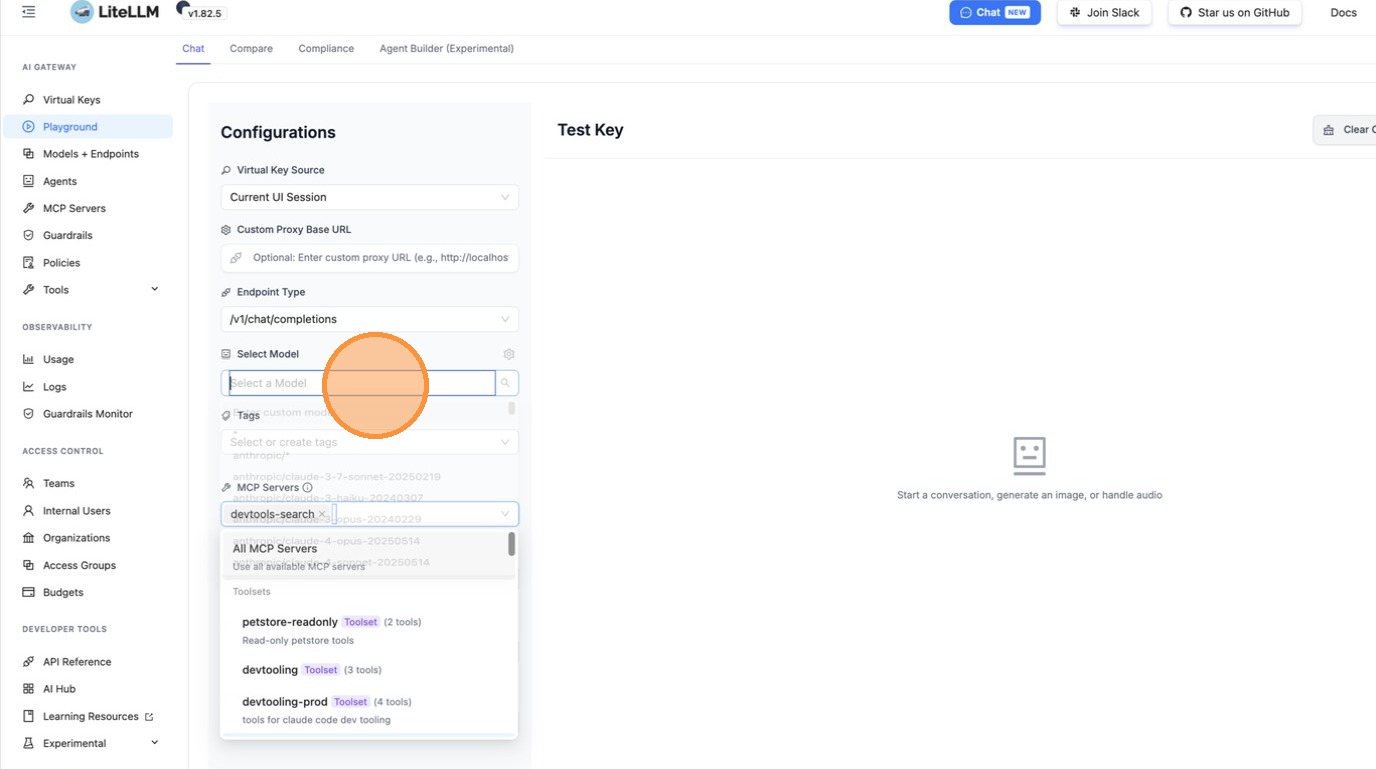
The model now has access to exactly the tools in your toolset and nothing else.
Use a toolset via API
Pass the toolset's route as the server_url in your tools list. LiteLLM resolves it server-side — no public URL needed.
import openai

client = openai.OpenAI(
    api_key="your-litellm-key",
    base_url="http://your-proxy/v1",
)

response = client.responses.create(
    model="gpt-4o",
    input="What CI/CD tools do you have?",
    tools=[
        {
            "type": "mcp",
            "server_label": "devtooling-prod",
            "server_url": "litellm_proxy/mcp/devtooling-prod",
            "require_approval": "never",
        }
    ],
)
print(response.output_text)
import openai

client = openai.OpenAI(
    api_key="your-litellm-key",
    base_url="http://your-proxy/v1",
)

response = client.chat.completions.create(
    model="gpt-4o",
    messages=[{"role": "user", "content": "What CI/CD tools do you have?"}],
    tools=[
        {
            "type": "mcp",
            "server_label": "devtooling-prod",
            "server_url": "litellm_proxy/mcp/devtooling-prod",
            "require_approval": "never",
        }
    ],
)
print(response.choices[0].message.content)
curl http://your-proxy/v1/responses \
  -H "Authorization: Bearer your-litellm-key" \
  -H "Content-Type: application/json" \
  -d '{
    "model": "gpt-4o",
    "input": "What CI/CD tools do you have?",
    "tools": [
      {
        "type": "mcp",
        "server_label": "devtooling-prod",
        "server_url": "litellm_proxy/mcp/devtooling-prod",
        "require_approval": "never"
      }
    ]
  }'
Manage toolsets via API
# List all toolsets
curl http://your-proxy/v1/mcp/toolset \
  -H "Authorization: Bearer your-litellm-key"

# Create a toolset
curl -X POST http://your-proxy/v1/mcp/toolset \
  -H "Authorization: Bearer your-litellm-key" \
  -H "Content-Type: application/json" \
  -d '{
    "toolset_name": "devtooling-prod",
    "description": "CircleCI + DeepWiki tools for the dev team",
    "tools": [
      {"server_id": "<circleci-server-id>", "tool_name": "get_build_failure_logs"},
      {"server_id": "<circleci-server-id>", "tool_name": "run_pipeline"},
      {"server_id": "<deepwiki-server-id>", "tool_name": "read_wiki_structure"}
    ]
  }'

# Delete a toolset
curl -X DELETE http://your-proxy/v1/mcp/toolset/<toolset_id> \
  -H "Authorization: Bearer your-litellm-key"