








A memory management toolkit for AI agents — Remember Me, Refine Me.
> For the older version, please refer to the [0.2.x documentation](docs/README_0_2_x.md).
---
🧠 ReMe is a memory management framework designed for **AI agents**, providing both file-based and vector-based memory
systems.
It tackles two core problems of agent memory: **limited context window** (early information is truncated or lost in long
conversations) and **stateless sessions** (new sessions cannot inherit history and always start from scratch).
ReMe gives agents **real memory** — old conversations are automatically compacted, important information is persistently
stored, and relevant context is automatically recalled in future interactions.
---
## 📁 File-based memory system (ReMeLight)
> Memory as files, files as memory.
Treat **memory as files** — readable, editable, and copyable.
[CoPaw](https://github.com/agentscope-ai/CoPaw) integrates long-term memory and context management by inheriting from
`ReMeLight`.
| Traditional memory system | File-based ReMe |
|---------------------------|----------------------|
| 🗄️ Database storage | 📝 Markdown files |
| 🔒 Opaque | 👀 Always readable |
| ❌ Hard to modify | ✏️ Directly editable |
| 🚫 Hard to migrate | 📦 Copy to migrate |
```
working_dir/
├── MEMORY.md # Long-term memory: persistent info such as user preferences
├── memory/
│ └── YYYY-MM-DD.md # Daily journal: automatically written after each conversation
└── tool_result/ # Cache for long tool outputs (auto-managed, expired entries auto-cleaned)
└── .txt
```
### Core capabilities
[ReMeLight](reme/reme_light.py) is the core class of the file-based memory system. It provides full memory management
capabilities for AI agents:
| Method | Function | Key components |
|-----------------------|--------------------------------------|---------------------------------------------------------------------------------------------------------------------------------------------------------------------------------------------|
| `check_context` | 📊 Check context size | [ContextChecker](reme/memory/file_based/components/context_checker.py) — checks whether context exceeds thresholds and splits messages |
| `compact_memory` | 📦 Compact history into summary | [Compactor](reme/memory/file_based/components/compactor.py) — ReActAgent that generates structured context summaries |
| `summary_memory` | 📝 Persist important memory to files | [Summarizer](reme/memory/file_based/components/summarizer.py) — ReActAgent + file tools (`read` / `write` / `edit`) |
| `compact_tool_result` | ✂️ Compact long tool outputs | [ToolResultCompactor](reme/memory/file_based/components/tool_result_compactor.py) — truncates long tool outputs and stores them in `tool_result/` while keeping file references in messages |
| `memory_search` | 🔍 Semantic memory search | [MemorySearch](reme/memory/file_based/tools/memory_search.py) — hybrid retrieval with vectors + BM25 |
| `ReMeInMemoryMemory` | 🗂️ In-session memory class | [ReMeInMemoryMemory](reme/memory/file_based/reme_in_memory_memory.py) — token-aware memory management with summary compression and state serialization |
| `pre_reasoning_hook` | 🔄 Pre-reasoning hook | `compact_tool_result` + `check_context` + `compact_memory` + `summary_memory` (async) |
| `start` | 🚀 Start memory system | Initialize file storage, file watcher, and embedding cache; clean up expired tool result files |
| `close` | 📕 Shutdown and cleanup | Clean up tool result files, stop file watcher, and persist embedding cache |
---
### 🚀 Quick start
#### Installation
```bash
pip install -e ".[light]"
```
#### Environment variables
`ReMeLight` uses environment variables to configure the embedding model and storage backends:
| Variable | Description | Example |
|----------------------|-------------------------------|-----------------------------------------------------|
| `LLM_API_KEY` | LLM API key | `sk-xxx` |
| `LLM_BASE_URL` | LLM base URL | `https://dashscope.aliyuncs.com/compatible-mode/v1` |
| `EMBEDDING_API_KEY` | Embedding API key (optional) | `sk-xxx` |
| `EMBEDDING_BASE_URL` | Embedding base URL (optional) | `https://dashscope.aliyuncs.com/compatible-mode/v1` |
#### Python usage
```python
import asyncio
from reme.reme_light import ReMeLight
async def main():
# Initialize ReMeLight
reme = ReMeLight(
default_as_llm_config={"model_name": "qwen3.5-35b-a3b"},
# default_embedding_model_config={"model_name": "text-embedding-v4"},
default_file_store_config={"fts_enabled": True, "vector_enabled": False},
)
await reme.start()
messages = [...] # List of conversation messages
# 1. Compact long tool outputs (prevent tool results from blowing up context)
messages = await reme.compact_tool_result(messages)
# 2. Compact conversation history into a structured summary
summary = await reme.compact_memory(
messages=messages,
previous_summary="",
max_input_length=128000, # Model context window (tokens)
compact_ratio=0.7, # Trigger compaction when exceeding max_input_length * 0.7
language="zh", # Summary language (e.g., "zh" / "")
)
# 3. Submit summary task asynchronously (non-blocking, writes to memory/YYYY-MM-DD.md)
reme.add_async_summary_task(messages=messages)
# 4. Pre-reasoning hook (auto compact tool results + generate summaries)
processed_messages, compressed_summary = await reme.pre_reasoning_hook(
messages=messages,
system_prompt="You are a helpful AI assistant.",
compressed_summary="",
max_input_length=128000,
compact_ratio=0.7,
memory_compact_reserve=10000,
enable_tool_result_compact=True,
tool_result_compact_keep_n=3,
)
# 5. Semantic memory search (vector + BM25 hybrid retrieval)
result = await reme.memory_search(query="Python version preference", max_results=5)
# 6. Create in-session memory instance (manages context for one conversation)
from reme.memory.file_based.reme_in_memory_memory import ReMeInMemoryMemory
memory = ReMeInMemoryMemory()
for msg in messages:
await memory.add(msg)
token_stats = await memory.estimate_tokens(max_input_length=128000)
print(f"Current context usage: {token_stats['context_usage_ratio']:.1f}%")
print(f"Message token count: {token_stats['messages_tokens']}")
print(f"Estimated total tokens: {token_stats['estimated_tokens']}")
# 7. Wait for background summary tasks to complete before shutdown
summary_result = await reme.await_summary_tasks()
# Shutdown ReMeLight
await reme.close()
if __name__ == "__main__":
asyncio.run(main())
```
> 📂 Full example: [test_reme_light.py](tests/light/test_reme_light.py)
> 📋 Sample run log: [test_reme_light_log.txt](tests/light/test_reme_light_log.txt) (223,838 tokens → 1,105 tokens, 99.5%
> compression)
### Architecture of the file-based ReMeLight memory system
[CoPaw MemoryManager](https://github.com/agentscope-ai/CoPaw/blob/main/src/copaw/agents/memory/memory_manager.py)
inherits
`ReMeLight` and integrates its memory capabilities into the agent reasoning loop:
```mermaid
graph LR
Agent[Agent] -->|Before each reasoning step| Hook[pre_reasoning_hook]
Hook --> TC[compact_tool_result
Compact tool outputs]
TC --> CC[check_context
Token counting]
CC -->|Exceeds limit| CM[compact_memory
Generate summary]
CC -->|Exceeds limit| SM[summary_memory
Async persistence]
SM -->|ReAct + FileIO| Files[memory/*.md]
Agent -->|Explicit call| Search[memory_search
Vector+BM25]
Agent -->|In - session| InMem[ReMeInMemoryMemory
Token-aware memory]
Files -.->|FileWatcher| Store[(FileStore
Vector+FTS index)]
Search --> Store
```
---
#### 1. `check_context` — context checking
[ContextChecker](reme/memory/file_based/components/context_checker.py) uses token counting to determine whether the
context exceeds thresholds and automatically splits messages into a "to compact" group and a "to keep" group.
```mermaid
graph LR
M[messages] --> H[AsMsgHandler
Token counting]
H --> C{total > threshold?}
C -->|No| K[Return all messages]
C -->|Yes| S[Keep from tail
reserve tokens]
S --> CP[messages_to_compact
Earlier messages]
S --> KP[messages_to_keep
Recent messages]
S --> V{is_valid
Tool calls aligned?}
```
- **Core logic**: keep `reserve` tokens from the tail; mark the rest as messages to compact.
- **Integrity guarantee**: preserves complete user-assistant turns and tool_use/tool_result pairs without splitting
them.
---
#### 2. `compact_memory` — conversation compaction
[Compactor](reme/memory/file_based/components/compactor.py) uses a ReActAgent to compact conversation history into a *
*structured context summary**.
```mermaid
graph LR
M[messages] --> H[AsMsgHandler
format_msgs_to_str]
H --> A[ReActAgent
reme_compactor]
P[previous_summary] -->|Incremental update| A
A --> S[Structured summary
Goal/Progress/Decisions...]
```
**Summary structure** (context checkpoints):
| Field | Description |
|-----------------------|------------------------------------------------------------------------|
| `## Goal` | User goals |
| `## Constraints` | Constraints and preferences |
| `## Progress` | Task progress |
| `## Key Decisions` | Key decisions |
| `## Next Steps` | Next step plans |
| `## Critical Context` | Critical data such as file paths, function names, error messages, etc. |
- **Incremental updates**: when `previous_summary` is provided, new conversations are merged into the existing summary.
---
#### 3. `summary_memory` — persistent memory
[Summarizer](reme/memory/file_based/components/summarizer.py) uses a **ReAct + file tools** pattern so that the AI can
decide what to write and where to write it.
```mermaid
graph LR
M[messages] --> A[ReActAgent
reme_summarizer]
A -->|read| R[Read memory/YYYY-MM-DD.md]
R --> T{Reason: how to merge?}
T -->|write| W[Overwrite]
T -->|edit| E[Edit in place]
W --> F[memory/YYYY-MM-DD.md]
E --> F
```
**File tools** ([FileIO](reme/memory/file_based/tools/file_io.py)):
| Tool | Function |
|---------|-----------------------|
| `read` | Read file content |
| `write` | Overwrite file |
| `edit` | Find-and-replace edit |
---
#### 4. `compact_tool_result` — tool result compaction
[ToolResultCompactor](reme/memory/file_based/components/tool_result_compactor.py) addresses the problem of long tool
outputs bloating the context.
```mermaid
graph LR
M[messages] --> L{Iterate tool_result
len > threshold?}
L -->|No| K[Keep as-is]
L -->|Yes| T[truncate_text
Truncate to threshold]
T --> S[Write full content
tool_result/uuid.txt]
S --> R[Append file path reference
to message]
R --> C[cleanup_expired_files
Delete expired files]
```
- **Auto cleanup**: expired files (older than `retention_days`) are deleted automatically during `start` / `close` /
`compact_tool_result`.
---
#### 5. `memory_search` — memory retrieval
[MemorySearch](reme/memory/file_based/tools/memory_search.py) provides **vector + BM25 hybrid retrieval**.
```mermaid
graph LR
Q[query] --> E[Embedding
Vectorization]
E --> V[vector_search
Semantic similarity]
Q --> B[BM25
Keyword matching]
V -->|" weight: 0.7 "| M[Deduplicate + weighted merge]
B -->|" weight: 0.3 "| M
M --> F[min_score filter]
F --> R[Top-N results]
```
- **Fusion mechanism**: vector weight 0.7 + BM25 weight 0.3 — balancing semantic similarity and exact matches.
---
#### 6. `ReMeInMemoryMemory` — in-session memory
[ReMeInMemoryMemory](reme/memory/file_based/reme_in_memory_memory.py) extends AgentScope's `InMemoryMemory` to provide
token-aware memory management.
```mermaid
graph LR
C[content] --> G[get_memory
exclude_mark=COMPRESSED]
G --> F[Filter out compressed messages]
F --> P{prepend_summary?}
P -->|Yes| S[Prepend previous summary]
S --> O[Output messages]
P -->|No| O
```
| Function | Description |
|----------------------------------|---------------------------------------------------|
| `get_memory` | Filter messages by mark and auto-append summary |
| `estimate_tokens` | Estimate token usage of the context |
| `state_dict` / `load_state_dict` | Serialize/deserialize state (session persistence) |
---
#### 7. `pre_reasoning_hook` — pre-reasoning processing
This is a unified entry point that wires all the above components together and automatically manages context before each
reasoning step.
```mermaid
graph LR
M[messages] --> TC[compact_tool_result
Compact long tool outputs]
TC --> CC[check_context
Compute remaining space]
CC --> D{messages_to_compact
Non-empty?}
D -->|No| K[Return original messages + summary]
D -->|Yes| V{is_valid?}
V -->|No| K
V -->|Yes| CM[compact_memory
Sync summary generation]
V -->|Yes| SM[add_async_summary_task
Async persistence]
CM --> R[Return messages_to_keep + new summary]
```
**Execution flow**:
1. `compact_tool_result` — compact long tool outputs.
2. `check_context` — check whether the context exceeds limits.
3. `compact_memory` — generate compact summary (sync).
4. `summary_memory` — persist memory (async in the background).
---
## 🗃️ Vector-based memory system
[ReMe Vector Based](reme/reme.py) is the core class for the vector-based memory system. It manages three types of
memories:
| Memory type | Use case |
|-----------------------|-------------------------------------------------------------------|
| **Personal memory** | Records user preferences and habits |
| **Procedural memory** | Records task execution experience and patterns of success/failure |
| **Tool memory** | Records tool usage experience and parameter tuning |
### Core capabilities
| Method | Function | Description |
|--------------------|--------------|-------------------------------------------------------------|
| `summarize_memory` | 🧠 Summarize | Automatically extract and store memories from conversations |
| `retrieve_memory` | 🔍 Retrieve | Retrieve related memories based on a query |
| `add_memory` | ➕ Add | Manually add memories into the vector store |
| `get_memory` | 📖 Get | Get a single memory by ID |
| `update_memory` | ✏️ Update | Update existing memory content or metadata |
| `delete_memory` | 🗑️ Delete | Delete a specific memory |
| `list_memory` | 📋 List | List memories with filtering and sorting |
### Installation and environment variables
Installation and environment configuration are the same as [ReMeLight](#installation).
API keys are configured via environment variables and can be stored in a `.env` file at the project root.
### Python usage
```python
import asyncio
from reme import ReMe
async def main():
# Initialize ReMe
reme = ReMe(
working_dir=".reme",
default_llm_config={
"backend": "openai",
"model_name": "qwen3.5-plus",
},
default_embedding_model_config={
"backend": "openai",
"model_name": "text-embedding-v4",
"dimensions": 1024,
},
default_vector_store_config={
"backend": "local", # Supports local/chroma/qdrant/elasticsearch
},
)
await reme.start()
messages = [
{"role": "user", "content": "Help me write a Python script", "time_created": "2026-02-28 10:00:00"},
{"role": "assistant", "content": "Sure, I'll help you with that.", "time_created": "2026-02-28 10:00:05"},
]
# 1. Summarize memories from conversation (automatically extract user preferences, task experience, etc.)
result = await reme.summarize_memory(
messages=messages,
user_name="alice", # Personal memory
# task_name="code_writing", # Procedural memory
)
print(f"Summary result: {result}")
# 2. Retrieve related memories
memories = await reme.retrieve_memory(
query="Python programming",
user_name="alice",
# task_name="code_writing",
)
print(f"Retrieved memories: {memories}")
# 3. Manually add a memory
memory_node = await reme.add_memory(
memory_content="The user prefers concise code style.",
user_name="alice",
)
print(f"Added memory: {memory_node}")
memory_id = memory_node.memory_id
# 4. Get a single memory by ID
fetched_memory = await reme.get_memory(memory_id=memory_id)
print(f"Fetched memory: {fetched_memory}")
# 5. Update memory content
updated_memory = await reme.update_memory(
memory_id=memory_id,
user_name="alice",
memory_content="The user prefers concise code with comments.",
)
print(f"Updated memory: {updated_memory}")
# 6. List all memories for the user (supports filtering and sorting)
all_memories = await reme.list_memory(
user_name="alice",
limit=10,
sort_key="time_created",
reverse=True,
)
print(f"User memory list: {all_memories}")
# 7. Delete a specific memory
await reme.delete_memory(memory_id=memory_id)
print(f"Deleted memory: {memory_id}")
# 8. Delete all memories (use with care)
# await reme.delete_all()
await reme.close()
if __name__ == "__main__":
asyncio.run(main())
```
### Technical architecture
```mermaid
graph LR
User[User / Agent] --> ReMe[Vector Based ReMe]
ReMe --> Summarize[Summarize memories]
ReMe --> Retrieve[Retrieve memories]
ReMe --> CRUD[CRUD operations]
Summarize --> PersonalSum[PersonalSummarizer]
Summarize --> ProceduralSum[ProceduralSummarizer]
Summarize --> ToolSum[ToolSummarizer]
Retrieve --> PersonalRet[PersonalRetriever]
Retrieve --> ProceduralRet[ProceduralRetriever]
Retrieve --> ToolRet[ToolRetriever]
PersonalSum --> VectorStore[Vector database]
ProceduralSum --> VectorStore
ToolSum --> VectorStore
PersonalRet --> VectorStore
ProceduralRet --> VectorStore
ToolRet --> VectorStore
```
### Experimental results
Coming soon...
---
## 🧪 Procedural memory paper
> Our procedural (task) memory paper is available on [arXiv](https://arxiv.org/abs/2512.10696).
### 🌍 [Appworld benchmark](benchmark/appworld/quickstart.md)
We evaluate ReMe on the Appworld environment using Qwen3-8B (non-thinking mode):
| Method | Avg@4 | Pass@4 |
|----------|---------------------|---------------------|
| w/o ReMe | 0.1497 | 0.3285 |
| w/ ReMe | 0.1706 **(+2.09%)** | 0.3631 **(+3.46%)** |
Pass@K measures the probability that at least one of K generated candidates successfully completes the task (score=1).
The current experiments use an internal AppWorld environment, which may differ slightly from the public version.
For more details on how to reproduce the experiments, see [quickstart.md](benchmark/appworld/quickstart.md).
### 🔧 [BFCL-V3 benchmark](benchmark/bfcl/quickstart.md)
We evaluate ReMe on the BFCL-V3 multi-turn-base task (random split 50 train / 150 val) using Qwen3-8B (thinking mode):
| Method | Avg@4 | Pass@4 |
|----------|---------------------|---------------------|
| w/o ReMe | 0.4033 | 0.5955 |
| w/ ReMe | 0.4450 **(+4.17%)** | 0.6577 **(+6.22%)** |
For more details on how to reproduce the experiments, see [quickstart.md](benchmark/bfcl/quickstart.md).
## ⭐ Community & support
- **Star & Watch**: Starring helps more agent developers discover ReMe; Watching keeps you up to date with new releases
and features.
- **Share your results**: Share how ReMe empowers your agents in Issues or Discussions — we are happy to showcase great
community use cases.
- **Need a new feature?** Open a feature request; we’ll evolve ReMe together with the community.
- **Code contributions**: All forms of contributions are welcome. Please see
the [contribution guide](docs/contribution.md).
- **Acknowledgements**: We thank excellent open-source projects such as OpenClaw, Mem0, MemU, and CoPaw for their
inspiration and support.
---
## 📄 Citation
```bibtex
@software{AgentscopeReMe2025,
title = {AgentscopeReMe: Memory Management Kit for Agents},
author = {ReMe Team},
url = {https://reme.agentscope.io},
year = {2025}
}
```
---
## ⚖️ License
This project is open-sourced under the Apache License 2.0. See [LICENSE](./LICENSE) for details.
---
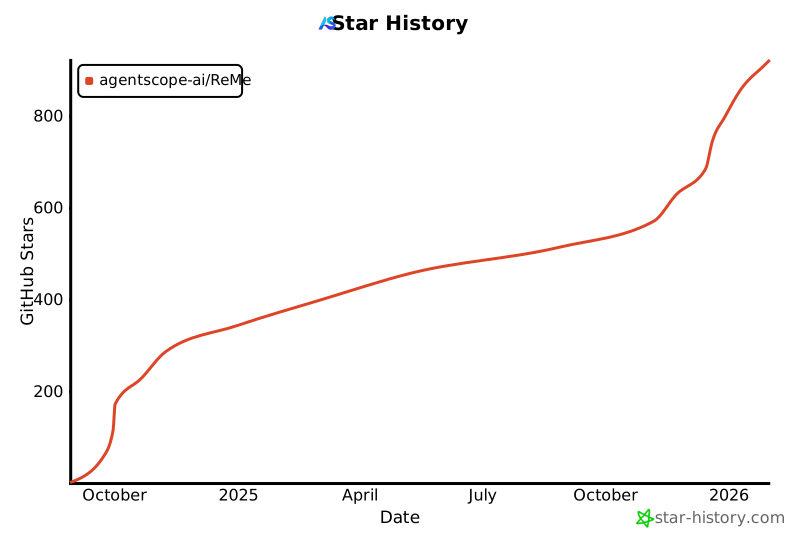
## 📈 Star history
[](https://www.star-history.com/#agentscope-ai/ReMe&Date)