mirror of
https://github.com/abhigyanpatwari/GitNexus.git
synced 2026-10-05 02:43:32 +00:00
 50c6acb108
* feat(setup): implement antigravity integration setup and hook adapter for gitnexus

* docs(readme): list Antigravity in supported editors

* test(setup-antigravity): pin platform per-test to fix Windows CI failure

The MCP entry assertion expected `npx` directly, but on Windows
`getMcpEntry()` wraps it as `cmd /c npx ...`, which broke the Windows
runner. Pin platform to darwin in beforeEach so the existing assertion
is deterministic, restore the descriptor in afterEach, and add a
parity test for the win32 cmd-wrapper shape.

* fix(antigravity): align hook adapter to Gemini CLI schema + fix Windows CI

Rebase the Antigravity integration on the canonical Gemini CLI hooks
contract (https://geminicli.com/docs/hooks/reference/), which is the
documented schema Antigravity 2.0 inherits:

- Hook adapter: replace PreToolUse/PostToolUse with the single AfterTool
  event. BeforeTool has no documented context-injection channel in the
  Gemini contract, so augmentation runs in AfterTool where
  hookSpecificOutput.additionalContext is the documented way to append
  text to the tool result the agent reads. Stale-index hints land in the
  same channel (so the agent sees them) and are mirrored to stderr for
  terminal users. Tool-name matcher updated to Gemini CLI snake_case
  (search_file_content|glob|run_shell_command).
- Setup: write hooks to ~/.gemini/settings.json under canonical
  hooks.AfterTool[] (replaces the ad-hoc hooks.json top-level group).
  Polite-neighbor merge preserves existing user hooks. Also copy
  win-rm-list-json.ps1 alongside hook-db-lock-probe.cjs so the Windows
  MCP server ownership probe doesn't silently fail open.
- Tests: 17 regression tests covering MCP write, win32 shape, hook
  schema, polite-neighbor merge, idempotency, adapter context emission,
  stale-index hint, and skill layout.
- README: footnote documenting the AfterTool design choice and a link
  to the Gemini CLI hooks reference.

Windows CI fix: installSkillsTo previously used glob('*.md') +
glob('*/SKILL.md'), which returned zero matches under the Windows
runner's temp paths (8.3 short-name like RUNNER~1). Replace with
fs.readdir + dirent type checks — same behavior, no path quirks. This
fixes the only failing Windows job on the PR.

* fix(antigravity): address PR review — windowsHide, stale docs, dead code

Addresses the production-readiness review findings on PR #1730:

- F1 (blocker): add windowsHide:true to all four spawnSync sites in the
  Antigravity hook adapter (findCanonicalRepoRoot, runGitNexusCli's two
  branches, buildStaleIndexHint) so they don't flash console windows on
  Windows. Matches the fix #1794 already on main for the Claude hook.
- F2 (blocker): update gitnexus/README.md editor table to say AfterTool
  and link the Gemini CLI hooks reference. The published README had
  drifted to the pre-c1872b4 PreToolUse + PostToolUse schema.
- F3: rewrite the stale ~/.gemini block comment in setup.ts. It still
  described the old hooks.json + gitnexus group + grep_search design.
- F4: remove grep_search dead code from extractPattern and its doc
  comment. The registered matcher is search_file_content|glob|run_shell_command,
  so grep_search would never be invoked.
- F5: annotate timeout:10000 with a ms-unit comment noting Gemini CLI
  uses milliseconds (Claude Code uses seconds).
- F6: add the GITNEXUS_DEBUG branch to extractAugmentContext for parity
  with the Claude adapter, so suppressed augment stderr is recoverable.
- F7: stageAdapter test helper now copies win-rm-list-json.ps1 alongside
  the .cjs helpers, so the adapter's Windows lock-probe path isn't a
  silent fail-open in child-process smoke tests.

* test(antigravity): add integration tests and register in cross-platform matrix

Adds end-to-end coverage on top of the unit-level tests, per maintainer
request:

- test/integration/setup-antigravity.test.ts (10 tests): exercises the
  real setupCommand() against a temp HOME with ~/.gemini/antigravity/
  present. Verifies mcp_config.json shape, ~/.gemini/settings.json
  AfterTool entry, adapter + helpers + win-rm-list-json.ps1 copy,
  baked-in cliPath rewrite (issue #108 regression class), skill layout,
  polite-neighbor merge against existing user hooks, idempotency,
  skip-when-absent, corrupt-file safety, and key preservation.
- test/integration/antigravity-hook-e2e.test.ts (19 tests): runs the
  full install-then-execute flow — invokes setupCommand to lay down
  the adapter + helpers, then spawns the INSTALLED adapter as a real
  child process against a temp git repo + .gitnexus/. The source
  adapter cannot be spawned directly (it requires sibling .cjs helpers
  that only live in hooks/claude/); install-then-spawn mirrors the
  production codepath. Covers staleness detection across all five git
  mutation types, --embeddings propagation, polite skip on
  toolResponse.error / exit_code !== 0, augment crash-free behavior,
  cwd validation, corrupted/missing meta.json, unknown event names,
  empty stdin, and the no-.gitnexus deep-nested case.
- scripts/cross-platform-tests.ts: registers all three antigravity
  test files (unit in PLATFORM_LOGIC, two integration files in
  SPAWN_CLI) so Windows and macOS CI exercise them on every run.

* fix(antigravity): review fixes — dedup, silent-failure guard, type coercion, glob filter

- Delete mergeGeminiSettingsHooks (verbatim copy of mergeHooksJsonc),
  replace call site with the original
- Unify geminiHasGitnexusHook into hasGitnexusHook with commandFragment
  parameter; delete the duplicate
- Guard against silent adapter-copy failure: verify the adapter file
  exists before registering the AfterTool hook entry in settings.json;
  surface helper copy errors instead of swallowing
- Fix toolSucceeded type coercion: use Number() so string exit_code
  values from Gemini CLI are handled correctly
- Align glob tool extractPattern with Claude adapter's restrictive
  regex filter (/[*\/]([a-zA-Z][a-zA-Z0-9_-]{2,})/)
- Remove bounds-only toBeGreaterThan(0) assertion (DoD §2.7)
- Add antigravity adapter to HOOK_FILES windowsHide regression list

* chore(autofix): apply prettier + eslint fixes via /autofix command

* chore: trigger CI

---------

Co-authored-by: Gergő Magyar <gergomagyar@icloud.com>
Co-authored-by: Test <test@example.com>
Co-authored-by: github-actions[bot] <41898282+github-actions[bot]@users.noreply.github.com>
831 lines
48 KiB
Markdown
831 lines
48 KiB
Markdown
# GitNexus
|
||
|
||
**⚠️ Important Notice:** GitNexus has NO official cryptocurrency, token, or coin. Any token/coin using the GitNexus name on Pump.fun or any other platform is **not affiliated with, endorsed by, or created by** this project or its maintainers. Do not purchase any cryptocurrency claiming association with GitNexus.
|
||
|
||
<div align="center">
|
||
|
||
<a href="https://trendshift.io/repositories/19809" target="_blank">
|
||
<img src="https://trendshift.io/api/badge/repositories/19809" alt="abhigyanpatwari%2FGitNexus | Trendshift" style="width: 250px; height: 55px;" width="250" height="55"/>
|
||
</a>
|
||
|
||
<h2>Join the official Discord to discuss ideas, issues etc!</h2>
|
||
|
||
<a href="https://discord.gg/MgJrmsqr62">
|
||
<img src="https://img.shields.io/discord/1477255801545429032?color=5865F2&logo=discord&logoColor=white" alt="Discord"/>
|
||
</a>
|
||
<a href="https://www.npmjs.com/package/gitnexus">
|
||
<img src="https://img.shields.io/npm/v/gitnexus.svg" alt="npm version"/>
|
||
</a>
|
||
<a href="https://polyformproject.org/licenses/noncommercial/1.0.0/">
|
||
<img src="https://img.shields.io/badge/License-PolyForm%20Noncommercial-blue.svg" alt="License: PolyForm Noncommercial"/>
|
||
</a>
|
||
<a href="https://securityscorecards.dev/viewer/?uri=github.com/abhigyanpatwari/GitNexus">
|
||
<img src="https://api.securityscorecards.dev/projects/github.com/abhigyanpatwari/GitNexus/badge" alt="OpenSSF Scorecard"/>
|
||
</a>
|
||
|
||
<p><strong>Enterprise (SaaS & Self-hosted)</strong> - <a href="https://akonlabs.com">akonlabs.com</a></p>
|
||
|
||
</div>
|
||
|
||
**Building nervous system for agent context.**
|
||
|
||
Indexes any codebase into a knowledge graph — every dependency, call chain, cluster, and execution flow — then exposes it through smart tools so AI agents never miss code.
|
||
|
||
https://github.com/user-attachments/assets/172685ba-8e54-4ea7-9ad1-e31a3398da72
|
||
|
||
> _Like DeepWiki, but deeper._ DeepWiki helps you _understand_ code. GitNexus lets you _analyze_ it — because a knowledge graph tracks every relationship, not just descriptions.
|
||
|
||
**TL;DR:** The **Web UI** is a quick way to chat with any repo. The **CLI + MCP** is how you make your AI agent actually reliable — it gives Cursor, Claude Code, Antigravity, Codex, and friends a deep architectural view of your codebase so they stop missing dependencies, breaking call chains, and shipping blind edits. Even smaller models get full architectural clarity, making it compete with Goliath models.
|
||
|
||
---
|
||
|
||
## Star History
|
||
|
||
[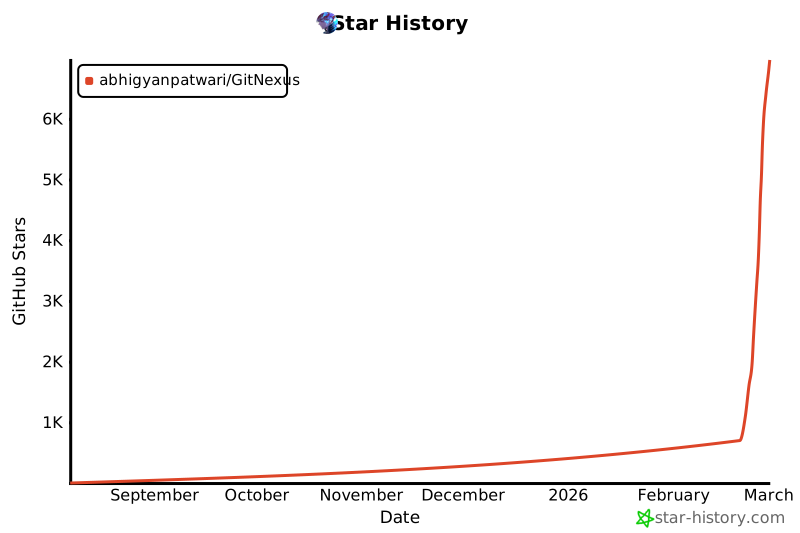](https://www.star-history.com/#abhigyanpatwari/GitNexus&type=date&legend=top-left)
|
||
|
||
## Two Ways to Use GitNexus
|
||
|
||
| | **CLI + MCP** | **Web UI** |
|
||
| ----------- | --------------------------------------------------------------------- | -------------------------------------------------------------------- |
|
||
| **What** | Index repos locally, connect AI agents via MCP | Visual graph explorer + AI chat in browser |
|
||
| **For** | Daily development with Cursor, Claude Code, Antigravity, Codex, Windsurf, OpenCode | Quick exploration, demos, one-off analysis |
|
||
| **Scale** | Full repos, any size | Limited by browser memory (~5k files), or unlimited via backend mode |
|
||
| **Install** | `npm install -g gitnexus` | No install — [gitnexus.vercel.app](https://gitnexus.vercel.app) |
|
||
| **Storage** | LadybugDB native (fast, persistent) | LadybugDB WASM (in-memory, per session) |
|
||
| **Parsing** | Tree-sitter native bindings | Tree-sitter WASM |
|
||
| **Privacy** | Everything local, no network | Everything in-browser, no server |
|
||
|
||
> **Bridge mode:** `gitnexus serve` connects the two — the web UI auto-detects the local server and can browse all your CLI-indexed repos without re-uploading or re-indexing.
|
||
|
||
---
|
||
|
||
## Enterprise
|
||
|
||
GitNexus is available as an **enterprise offering** - either as a fully managed **SaaS** or a **self-hosted** deployment. Also available for **commercial use** of the OSS version with proper licensing.
|
||
|
||
Enterprise includes:
|
||
|
||
- **PR Review** - automated blast radius analysis on pull requests
|
||
- **Auto-updating Code Wiki** - always up-to-date documentation (Code Wiki is also available in OSS)
|
||
- **Auto-reindexing** - knowledge graph stays fresh automatically
|
||
- **Multi-repo support** - unified graph across repositories
|
||
- **OCaml support** - additional language coverage
|
||
- **Priority feature/language support** - request new languages or features
|
||
|
||
**Upcoming:**
|
||
|
||
- Auto regression forensics
|
||
- End-to-end test generation
|
||
|
||
👉 Learn more at [akonlabs.com](https://akonlabs.com)
|
||
|
||
💬 For commercial licensing or enterprise inquiries, ping us on [Discord](https://discord.gg/AAsRVT6fGb) or drop an email at founders@akonlabs.com
|
||
|
||
---
|
||
|
||
## Development
|
||
|
||
- [ARCHITECTURE.md](ARCHITECTURE.md) — packages, index → graph → MCP flow, where to change code
|
||
- [RUNBOOK.md](RUNBOOK.md) — analyze, embeddings, stale index, MCP recovery, CI snippets
|
||
- [GUARDRAILS.md](GUARDRAILS.md) — safety rules and operational “Signs” for contributors and agents
|
||
- [CONTRIBUTING.md](CONTRIBUTING.md) — license, setup, commits, and pull requests
|
||
- [TESTING.md](TESTING.md) — test commands for `gitnexus` and `gitnexus-web`
|
||
|
||
## CLI + MCP (recommended)
|
||
|
||
The CLI indexes your repository and runs an MCP server that gives AI agents deep codebase awareness.
|
||
|
||
### Quick Start
|
||
|
||
```bash
|
||
# Index your repo (run from repo root)
|
||
npx gitnexus analyze
|
||
```
|
||
|
||
That's it. This indexes the codebase, installs agent skills, registers Claude Code hooks, and creates `AGENTS.md` / `CLAUDE.md` context files — all in one command.
|
||
|
||
To configure MCP for your editor, run `npx gitnexus setup` once — or set it up manually below.
|
||
|
||
> **Faster install (no C++ toolchain needed):** set `GITNEXUS_SKIP_OPTIONAL_GRAMMARS=1` before `npm install -g gitnexus` to skip vendored grammar materialize/build (`tree-sitter-dart`, `tree-sitter-proto`, `tree-sitter-swift`). Dart/Proto/Swift files won't be parsed, but install completes in seconds without `python3`/`make`/`g++`. Strict `=1` only — any other value falls through to the rebuild.
|
||
|
||
### MCP Setup
|
||
|
||
`gitnexus setup` auto-detects your editors and writes the correct global MCP config. You only need to run it once.
|
||
|
||
### Editor Support
|
||
|
||
| Editor | MCP | Skills | Hooks (auto-augment) | Support |
|
||
| -------------------- | --- | ------ | --------------------------------------------------------------------------------------- | ------------ |
|
||
| **Claude Code** | Yes | Yes | Yes (PreToolUse + PostToolUse) | **Full** |
|
||
| **Cursor** | Yes | Yes | Yes (postToolUse, [manual install](gitnexus-cursor-integration/README.md#hook-install)) | **Full** |
|
||
| **Antigravity** (Google) | Yes | Yes | Yes (AfterTool, [Gemini CLI hooks schema](https://geminicli.com/docs/hooks/reference/))[¹](#fn-antigravity-hooks) | **Full** |
|
||
| **Codex** | Yes | Yes | — | MCP + Skills |
|
||
| **Windsurf** | Yes | — | — | MCP |
|
||
| **OpenCode** | Yes | Yes | — | MCP + Skills |
|
||
|
||
> **Claude Code** gets the deepest integration: MCP tools + agent skills + PreToolUse hooks that enrich searches with graph context + PostToolUse hooks that detect a stale index after commits and prompt the agent to reindex.
|
||
|
||
<a id="fn-antigravity-hooks"></a>
|
||
> ¹ **Antigravity hooks** follow the [Gemini CLI hooks reference](https://geminicli.com/docs/hooks/reference/) (Antigravity 2.0 is the documented successor to Gemini CLI). Augmentation runs in `AfterTool` because `BeforeTool` has no context-injection channel in the Gemini contract — the agent sees graph context appended to the tool result via `hookSpecificOutput.additionalContext`. Stale-index hints land in the same channel after a successful `git commit/merge/rebase/cherry-pick/pull`. The schema may evolve if Antigravity-specific hook docs diverge from Gemini CLI's; the implementation will track those changes.
|
||
|
||
## Community Integrations
|
||
|
||
Built by the community — not officially maintained, but worth checking out.
|
||
|
||
| Project | Author | Description |
|
||
| ----------------------------------------------------------------------------- | ------------------------------------------------------ | ----------------------------------------------------------------------- |
|
||
| [pi-gitnexus](https://github.com/tintinweb/pi-gitnexus) | [@tintinweb](https://github.com/tintinweb) | GitNexus plugin for [pi](https://pi.dev) — `pi install npm:pi-gitnexus` |
|
||
| [gitnexus-stable-ops](https://github.com/ShunsukeHayashi/gitnexus-stable-ops) | [@ShunsukeHayashi](https://github.com/ShunsukeHayashi) | Stable ops & deployment workflows (Miyabi ecosystem) |
|
||
|
||
> Have a project built on GitNexus? Open a PR to add it here!
|
||
|
||
If you prefer manual configuration:
|
||
|
||
> **Recommended for fastest startup:** install gitnexus globally (`npm i -g gitnexus`) and run `gitnexus setup` — this writes an absolute-path MCP config that bypasses `npx` entirely. The pinned-`npx` snippets below are a quickstart fallback; on a cold cache the `npx` install can exceed Claude Code's `MCP_TIMEOUT` default (~30s).
|
||
|
||
**Claude Code** (full support — MCP + skills + hooks):
|
||
|
||
```bash
|
||
# macOS / Linux
|
||
claude mcp add gitnexus -- npx -y gitnexus@latest mcp
|
||
|
||
# Windows
|
||
claude mcp add gitnexus -- cmd /c npx -y gitnexus@latest mcp
|
||
```
|
||
|
||
**Codex** (full support — MCP + skills):
|
||
|
||
```bash
|
||
codex mcp add gitnexus -- npx -y gitnexus@latest mcp
|
||
```
|
||
|
||
**Cursor** (`~/.cursor/mcp.json` — global, works for all projects):
|
||
|
||
```json
|
||
{
|
||
"mcpServers": {
|
||
"gitnexus": {
|
||
"command": "npx",
|
||
"args": ["-y", "gitnexus@latest", "mcp"]
|
||
}
|
||
}
|
||
}
|
||
```
|
||
|
||
**Antigravity** (Google) — `~/.gemini/antigravity/mcp_config.json`:
|
||
|
||
```json
|
||
{
|
||
"mcpServers": {
|
||
"gitnexus": {
|
||
"command": "npx",
|
||
"args": ["-y", "gitnexus@latest", "mcp"]
|
||
}
|
||
}
|
||
}
|
||
```
|
||
|
||
> `gitnexus setup` also merges an `AfterTool` entry into `~/.gemini/settings.json` (under the canonical [Gemini CLI hooks schema](https://geminicli.com/docs/hooks/reference/)) and installs skills to `~/.gemini/antigravity/skills/`. Existing user hooks are preserved. The hook adapter's path is rewritten at install time, so run `gitnexus setup` rather than hand-editing.
|
||
|
||
**OpenCode** (`~/.config/opencode/config.json`):
|
||
|
||
```json
|
||
{
|
||
"mcp": {
|
||
"gitnexus": {
|
||
"type": "local",
|
||
"command": ["gitnexus", "mcp"]
|
||
}
|
||
}
|
||
}
|
||
```
|
||
|
||
**Codex** (`~/.codex/config.toml` for system scope, or `.codex/config.toml` for project scope):
|
||
|
||
```toml
|
||
[mcp_servers.gitnexus]
|
||
command = "npx"
|
||
args = ["-y", "gitnexus@latest", "mcp"]
|
||
```
|
||
|
||
### CLI Commands
|
||
|
||
```bash
|
||
gitnexus setup # Configure MCP for your editors (one-time)
|
||
gitnexus analyze [path] # Index a repository (or update stale index)
|
||
gitnexus analyze --repair-fts # Fast path: rebuild/verify only FTS indexes on existing index data
|
||
gitnexus analyze --force # Full rebuild: re-parse + graph rebuild + FTS rebuild
|
||
gitnexus analyze --skills # Generate repo-specific skill files from detected communities
|
||
gitnexus analyze --skip-embeddings # Skip embedding generation (faster)
|
||
gitnexus analyze --skip-agents-md # Preserve custom AGENTS.md/CLAUDE.md gitnexus section edits
|
||
gitnexus analyze --skip-git # Index folders that are not Git repositories
|
||
gitnexus analyze --embeddings # Enable embedding generation (slower, better search)
|
||
gitnexus analyze --verbose # Log skipped files when parsers are unavailable
|
||
gitnexus analyze --worker-timeout 60 # Increase worker idle timeout for slow parses
|
||
gitnexus analyze --wal-checkpoint-threshold 67108864 # 64 MiB. Control LadybugDB WAL auto-checkpoint threshold (default: 67108864 = 64 MiB; -1 keeps Ladybug stock ~16 MiB)
|
||
gitnexus analyze --workers <n> # Parse worker pool size (default: cores-1, capped at 16; 0 = sequential)
|
||
gitnexus mcp # Start MCP server (stdio) — serves all indexed repos
|
||
gitnexus serve # Start local HTTP server (multi-repo) for web UI connection
|
||
gitnexus list # List all indexed repositories
|
||
gitnexus status # Show index status for current repo
|
||
gitnexus clean # Delete index for current repo
|
||
gitnexus clean --all --force # Delete all indexes
|
||
gitnexus wiki [path] # Generate repository wiki from knowledge graph
|
||
gitnexus wiki --model <model> # Wiki with custom LLM model (default: gpt-4o-mini)
|
||
gitnexus wiki --base-url <url> # Wiki with custom LLM API base URL
|
||
gitnexus publish # Notify the understand-quickly registry (opt-in, see below)
|
||
|
||
# Repository groups (multi-repo / monorepo service tracking)
|
||
gitnexus group create <name> # Create a repository group
|
||
gitnexus group add <group> <groupPath> <registryName> # Add a repo to a group. <groupPath> is a hierarchy path (e.g. hr/hiring/backend); <registryName> is the repo's name from the registry (see `gitnexus list`)
|
||
gitnexus group remove <group> <groupPath> # Remove a repo from a group by its hierarchy path
|
||
gitnexus group list [name] # List groups, or show one group's config
|
||
gitnexus group sync <name> # Extract contracts and match across repos/services
|
||
gitnexus group contracts <name> # Inspect extracted contracts and cross-links
|
||
gitnexus group query <name> <q> # Search execution flows across all repos in a group
|
||
gitnexus group status <name> # Check staleness of repos in a group
|
||
```
|
||
|
||
If `analyze` reports a worker parse timeout on a large or unusual repository, it keeps running and falls back safely. To give slow worker jobs more time, use `gitnexus analyze --worker-timeout 60` or set `GITNEXUS_WORKER_SUB_BATCH_TIMEOUT_MS=60000`. For very large files, `GITNEXUS_WORKER_SUB_BATCH_MAX_BYTES` controls the worker job byte budget.
|
||
|
||
#### Environment variables
|
||
|
||
Most `analyze` knobs are also CLI flags (`--workers`, `--worker-timeout`, `--max-file-size`, `--verbose`). Use the env-var form when you'd otherwise repeat the same flag every run, or when invoking GitNexus from a long-running host (MCP server, eval-server, CI shell) that already manages its own environment. CLI flags take precedence over env vars; env vars take precedence over built-in defaults.
|
||
|
||
| Variable | Default | Effect | Tune when… |
|
||
| -------------------------------------- | ------------------------- | ---------------------------------------------------------------------------------------------------------------------------------------------------------- | ------------------------------------------------------------------------------------------------------------------------------------------- |
|
||
| `GITNEXUS_WORKER_POOL_SIZE` | `cores - 1`, capped at 16 | Parse worker pool size. `0` disables the pool (sequential fallback). Equivalent to `--workers <n>`. | Constrained containers (cgroup CPU limits), CI runners with explicit quotas, or debugging a worker-only crash via `0`. |
|
||
| `GITNEXUS_PARSE_CHUNK_CONCURRENCY` | `2` | Number of chunks whose file contents may be read into memory in parallel while the pool dispatches the current chunk. Worker dispatch itself stays serial. | Repos large enough to chunk (multi-MB total source) where disk I/O is a measurable fraction of analyze wall-clock. |
|
||
| `GITNEXUS_VERBOSE` | unset | When `1`, enables verbose ingestion logs (skipped-file warnings, per-chunk throughput, parse-cache stats). Equivalent to `--verbose`. | Debugging an analyze that "completed" but seems to have missed files; tuning `--workers` / chunk concurrency against observable throughput. |
|
||
| `GITNEXUS_PROFILE_DEFERRED` | unset | When `1`, emits `[deferred-profile]` timing/progress logs for the post-chunk deferred resolution band (imports → heritage → buildHeritageMap → legacy call resolution). Implied by `GITNEXUS_VERBOSE`. | Diagnosing analyze stalls in "Resolving calls (all chunks)" on large Java/Kotlin repos (issue #1741) without the full verbose ingestion noise. |
|
||
| `GITNEXUS_PROFILE_DEFERRED_SLOW_MS` | `3000` (verbose) / `5000` | Per-file threshold in ms above which `processCallsFromExtracted` emits a `slow file …` log line. Parsed via `Number()`: accepts integers (`5000`), scientific notation (`2.5e3`), decimals (`.5`), and hex (`0x10`). Non-finite or non-positive values fall back to the default. | Hunting a few outlier files dominating the deferred call-resolution stage; lower to surface more, raise to focus only on the worst. |
|
||
| `GITNEXUS_MAX_FILE_SIZE` | `512` (KB) | Walker skip threshold in KB. Hard cap is `32768` (tree-sitter buffer ceiling). Equivalent to `--max-file-size <kb>`. | Indexing repos with intentionally-large source files (generated parsers, vendored bundles) that should still be parsed. |
|
||
| `GITNEXUS_WORKER_SUB_BATCH_TIMEOUT_MS` | `30000` | Worker idle timeout in milliseconds before retry/fallback. Equivalent to `--worker-timeout <seconds>` × 1000. | Slow-parsing files (large minified JS, deeply-nested TS types) that legitimately need more than 30s. |
|
||
| `GITNEXUS_WAL_CHECKPOINT_THRESHOLD` | `67108864` (64 MiB) | LadybugDB WAL auto-checkpoint threshold in bytes. Equivalent to `--wal-checkpoint-threshold <bytes>`. `-1` keeps LadybugDB's stock threshold (~16 MiB). Larger thresholds reduce checkpoint frequency but increase the WAL size at rotation time — choose a smaller value on disk-constrained environments. | You need a larger or smaller WAL auto-checkpoint threshold for your analyze workload. |
|
||
| `GITNEXUS_WORKER_SUB_BATCH_MAX_BYTES` | `8388608` (8 MB) | Per-job byte budget the pool will send to a worker in one `postMessage`. | Very large individual files; mostly diagnostic — bumping past 8 MB risks structured-clone memory pressure. |
|
||
| `GITNEXUS_WORKER_MAX_RESPAWNS_PER_SLOT` | `3` | Max replacement spawns per worker slot before the slot is dropped from the active rotation. Bounds respawn loops on a chronically-crashing slot. | Hosts where a flaky worker should retry more (raise) or fail-fast (lower) before the slot is dropped. |
|
||
| `GITNEXUS_WORKER_MAX_CUMULATIVE_TIMEOUT_MS` | `5 × subBatchTimeoutMs` | Total retry wall-time budget per job before quarantining. Combined with `timeoutBackoffFactor`, prevents exponentially-growing retries from stalling for hours. | Slow files that legitimately need long total retry windows; lower to fail-fast on stalls. |
|
||
| `GITNEXUS_WORKER_CONSECUTIVE_FAILURE_THRESHOLD`| `max(3, poolSize)` | Per-slot consecutive deaths before the pool's circuit breaker trips. After tripping, every subsequent dispatch rejects until a fresh pool is created. | Hosts where a SIGSEGV-prone native grammar should trip the breaker sooner; CI runners that should fail loudly. |
|
||
| `GITNEXUS_CHUNK_BYTE_BUDGET` | `2097152` (2 MB) | Chunk boundary used for cache-key composition and dispatch. Smaller = finer-grained cache hits but more dispatch overhead. | Tuning incremental-analyze cache behavior on monorepos. |
|
||
| `GITNEXUS_NO_GITIGNORE` | unset | When set, skips `.gitignore` parsing. `.gitnexusignore` is still honored. | Indexing a repo whose `.gitignore` excludes files you actually want indexed (e.g., generated code committed for cross-repo lookup). |
|
||
| `GITNEXUS_SKIP_OPTIONAL_GRAMMARS` | unset | When `=1` strictly, skips vendored grammar materialize/build for `tree-sitter-dart`, `tree-sitter-proto`, and `tree-sitter-swift` at install time. | Installing on a host without a C++ toolchain or where Swift prebuilds don't match; you're willing to skip Dart/Proto/Swift parsing. |
|
||
|
||
#### Publishing to understand-quickly (opt-in)
|
||
|
||
[`looptech-ai/understand-quickly`](https://github.com/looptech-ai/understand-quickly) is a public registry of code-knowledge graphs that lists `gitnexus@1` as a first-class format. After registering your repo once (`npx @understand-quickly/cli add` or the [wizard](https://looptech-ai.github.io/understand-quickly/add.html)), `gitnexus publish` fires a single `repository_dispatch` event so the registry resyncs your entry on demand instead of waiting for the nightly job.
|
||
|
||
It is opt-in and a no-op without `UNDERSTAND_QUICKLY_TOKEN` — a fine-grained GitHub PAT with `Repository dispatches: write` on the registry repo. Nothing else happens; no graph file is uploaded. See the [protocol spec](https://github.com/looptech-ai/understand-quickly/blob/main/docs/integrations/protocol.md) for the full contract.
|
||
|
||
### What Your AI Agent Gets
|
||
|
||
**16 tools** exposed via MCP (11 per-repo + 5 group):
|
||
|
||
| Tool | What It Does | `repo` Param |
|
||
| ----------------- | ---------------------------------------------------------------- | ------------ |
|
||
| `list_repos` | Discover all indexed repositories | — |
|
||
| `query` | Process-grouped hybrid search (BM25 + semantic + RRF) | Optional |
|
||
| `context` | 360-degree symbol view — categorized refs, process participation | Optional |
|
||
| `impact` | Blast radius analysis with depth grouping and confidence | Optional |
|
||
| `detect_changes` | Git-diff impact — maps changed lines to affected processes | Optional |
|
||
| `rename` | Multi-file coordinated rename with graph + text search | Optional |
|
||
| `cypher` | Raw Cypher graph queries | Optional |
|
||
| `group_list` | List configured repository groups | — |
|
||
| `group_sync` | Extract contracts and match across repos/services | — |
|
||
| `group_contracts` | Inspect extracted contracts and cross-links | — |
|
||
| `group_query` | Search execution flows across all repos in a group | — |
|
||
| `group_status` | Check staleness of repos in a group | — |
|
||
|
||
> When only one repo is indexed, the `repo` parameter is optional. With multiple repos, specify which one: `query({query: "auth", repo: "my-app"})`.
|
||
|
||
**Resources** for instant context:
|
||
|
||
| Resource | Purpose |
|
||
| --------------------------------------- | ---------------------------------------------------- |
|
||
| `gitnexus://repos` | List all indexed repositories (read this first) |
|
||
| `gitnexus://repo/{name}/context` | Codebase stats, staleness check, and available tools |
|
||
| `gitnexus://repo/{name}/clusters` | All functional clusters with cohesion scores |
|
||
| `gitnexus://repo/{name}/cluster/{name}` | Cluster members and details |
|
||
| `gitnexus://repo/{name}/processes` | All execution flows |
|
||
| `gitnexus://repo/{name}/process/{name}` | Full process trace with steps |
|
||
| `gitnexus://repo/{name}/schema` | Graph schema for Cypher queries |
|
||
|
||
**2 MCP prompts** for guided workflows:
|
||
|
||
| Prompt | What It Does |
|
||
| --------------- | ------------------------------------------------------------------------- |
|
||
| `detect_impact` | Pre-commit change analysis — scope, affected processes, risk level |
|
||
| `generate_map` | Architecture documentation from the knowledge graph with mermaid diagrams |
|
||
|
||
**4 agent skills** installed to `.claude/skills/` automatically:
|
||
|
||
- **Exploring** — Navigate unfamiliar code using the knowledge graph
|
||
- **Debugging** — Trace bugs through call chains
|
||
- **Impact Analysis** — Analyze blast radius before changes
|
||
- **Refactoring** — Plan safe refactors using dependency mapping
|
||
|
||
**Repo-specific skills** generated with `--skills`:
|
||
|
||
When you run `gitnexus analyze --skills`, GitNexus detects the functional areas of your codebase (via Leiden community detection) and generates a `SKILL.md` file for each one under `.claude/skills/generated/`. Each skill describes a module's key files, entry points, execution flows, and cross-area connections — so your AI agent gets targeted context for the exact area of code you're working in. Skills are regenerated on each `--skills` run to stay current with the codebase.
|
||
|
||
---
|
||
|
||
## Multi-Repo MCP Architecture
|
||
|
||
GitNexus uses a **global registry** so one MCP server can serve multiple indexed repos. No per-project MCP config needed — set it up once and it works everywhere.
|
||
|
||
```mermaid
|
||
flowchart TD
|
||
subgraph CLI [CLI Commands]
|
||
Setup["gitnexus setup"]
|
||
Analyze["gitnexus analyze"]
|
||
Clean["gitnexus clean"]
|
||
List["gitnexus list"]
|
||
end
|
||
|
||
subgraph Registry ["~/.gitnexus/"]
|
||
RegFile["registry.json"]
|
||
end
|
||
|
||
subgraph Repos [Project Repos]
|
||
RepoA[".gitnexus/ in repo A"]
|
||
RepoB[".gitnexus/ in repo B"]
|
||
end
|
||
|
||
subgraph MCP [MCP Server]
|
||
Server["server.ts"]
|
||
Backend["LocalBackend"]
|
||
Pool["Connection Pool"]
|
||
ConnA["LadybugDB conn A"]
|
||
ConnB["LadybugDB conn B"]
|
||
end
|
||
|
||
Setup -->|"writes global MCP config"| CursorConfig["~/.cursor/mcp.json"]
|
||
Analyze -->|"registers repo"| RegFile
|
||
Analyze -->|"stores index"| RepoA
|
||
Clean -->|"unregisters repo"| RegFile
|
||
List -->|"reads"| RegFile
|
||
Server -->|"reads registry"| RegFile
|
||
Server --> Backend
|
||
Backend --> Pool
|
||
Pool -->|"lazy open"| ConnA
|
||
Pool -->|"lazy open"| ConnB
|
||
ConnA -->|"queries"| RepoA
|
||
ConnB -->|"queries"| RepoB
|
||
```
|
||
|
||
**How it works:** Each `gitnexus analyze` stores the index in `.gitnexus/` inside the repo (portable, gitignored) and registers a pointer in `~/.gitnexus/registry.json`. When an AI agent starts, the MCP server reads the registry and can serve any indexed repo. LadybugDB connections are opened lazily on first query and evicted after 5 minutes of inactivity (max 5 concurrent). If only one repo is indexed, the `repo` parameter is optional on all tools — agents don't need to change anything.
|
||
|
||
---
|
||
|
||
## Web UI (browser-based)
|
||
|
||
A client-side graph explorer and AI chat — your code never leaves your machine.
|
||
|
||
**Try it now:** [gitnexus.vercel.app](https://gitnexus.vercel.app) — run `npx gitnexus@latest serve` locally and the page auto-connects to your local backend.
|
||
|
||
<img width="2550" height="1343" alt="gitnexus_img" src="https://github.com/user-attachments/assets/cc5d637d-e0e5-48e6-93ff-5bcfdb929285" />
|
||
|
||
Or run the frontend locally:
|
||
|
||
```bash
|
||
git clone https://github.com/abhigyanpatwari/gitnexus.git
|
||
cd gitnexus/gitnexus-shared && npm install && npm run build
|
||
cd ../gitnexus-web && npm install
|
||
npm run dev
|
||
# Then in another terminal, start the backend the frontend connects to:
|
||
npx gitnexus@latest serve
|
||
```
|
||
|
||
## Docker
|
||
|
||
The official Docker setup ships **two signed images** orchestrated by `docker-compose.yaml`. Each image is published to both **GitHub Container Registry** (GHCR) and **Docker Hub** — same build, same digest, same Cosign signature — so pick whichever registry you prefer:
|
||
|
||
| Purpose | GHCR (default in `docker-compose.yaml`) | Docker Hub mirror |
|
||
| ---------------------------------------------------------------------- | --------------------------------------------- | ------------------------------ |
|
||
| CLI / `gitnexus serve` backend (HTTP API on port `4747`, MCP, indexer) | `ghcr.io/abhigyanpatwari/gitnexus:latest` | `akonlabs/gitnexus:latest` |
|
||
| Static web UI (port `4173`) | `ghcr.io/abhigyanpatwari/gitnexus-web:latest` | `akonlabs/gitnexus-web:latest` |
|
||
|
||
> **Heads-up — image rename.** Earlier releases published the web UI under
|
||
> `ghcr.io/abhigyanpatwari/gitnexus`. Starting with the introduction of the
|
||
> bundled backend, that slug now hosts the CLI/server image and the UI moved
|
||
> to `ghcr.io/abhigyanpatwari/gitnexus-web`. The previous tags remain
|
||
> available for pulling, but new versions are only published under the new
|
||
> slugs. Update your `docker run` / compose files accordingly (or just adopt
|
||
> the bundled compose).
|
||
|
||
### One-command setup
|
||
|
||
```bash
|
||
docker compose up -d
|
||
```
|
||
|
||
This starts the server on `http://localhost:4747` and the web UI on
|
||
`http://localhost:4173`. The UI auto-detects the server because the browser
|
||
runs on the host and reaches the container via the mapped port.
|
||
|
||
A named volume (`gitnexus-data`) persists the global registry, indexes, and
|
||
cloned repos at `/data/gitnexus` inside the server container. To make repos on
|
||
your host machine indexable, set `WORKSPACE_DIR` before bringing the stack up:
|
||
|
||
```bash
|
||
WORKSPACE_DIR=$HOME/code docker compose up -d
|
||
# Inside the server container the directory is mounted read-only at /workspace.
|
||
docker compose exec gitnexus-server gitnexus index /workspace/my-repo
|
||
```
|
||
|
||
### Direct `docker run`
|
||
|
||
```bash
|
||
# Server
|
||
docker run --rm -d \
|
||
--name gitnexus-server \
|
||
-p 4747:4747 \
|
||
-v gitnexus-data:/data/gitnexus \
|
||
ghcr.io/abhigyanpatwari/gitnexus:latest
|
||
|
||
# Web UI
|
||
docker run --rm -d \
|
||
--name gitnexus-web \
|
||
-p 4173:4173 \
|
||
ghcr.io/abhigyanpatwari/gitnexus-web:latest
|
||
```
|
||
|
||
Optional env file (override image tags, container names, ports, workspace dir):
|
||
|
||
```bash
|
||
cp .env.example .env
|
||
docker compose --env-file .env up -d
|
||
```
|
||
|
||
### Versioning & supply-chain protection
|
||
|
||
The Docker images are version-locked to the npm package:
|
||
|
||
- Stable images are **only published from `vX.Y.Z` git tags** (via `docker.yml`
|
||
triggered directly by the tag push), and the workflow refuses to build unless
|
||
the tag exactly matches `gitnexus/package.json`'s version. So
|
||
`ghcr.io/abhigyanpatwari/gitnexus:1.6.2` (and its Docker Hub mirror
|
||
`akonlabs/gitnexus:1.6.2`) is byte-for-byte the same release as
|
||
`npm install gitnexus@1.6.2` — no drift, no floating builds from `main`.
|
||
Both registries receive the same digest from a single build step, so you can
|
||
pull from either and the signature verifies identically.
|
||
- Release-candidate images (e.g. `:1.7.0-rc.1`) are published alongside each
|
||
RC npm release. They are built by `publish.yml` calling `docker.yml`
|
||
as a reusable workflow after the RC tag is created and pushed.
|
||
- `:latest` is auto-promoted only from non-prerelease tags by the Docker
|
||
metadata action, so it always points at a real, npm-published version.
|
||
|
||
Both images are signed with [Cosign keyless signing][cosign-keyless] using the
|
||
workflow's GitHub OIDC identity, and shipped with build provenance and SBOM
|
||
attestations. **This is your protection against supply-chain attacks**: even if
|
||
an attacker republishes a same-named image elsewhere (or somehow pushes to a
|
||
typo-squatted registry), they cannot forge a Cosign signature tied to
|
||
`abhigyanpatwari/GitNexus`'s `docker.yml`. Always verify before pulling into
|
||
sensitive environments:
|
||
|
||
**Stable releases** — signed from the `v*` tag ref:
|
||
|
||
```bash
|
||
cosign verify ghcr.io/abhigyanpatwari/gitnexus:1.6.2 \
|
||
--certificate-identity-regexp '^https://github\.com/abhigyanpatwari/GitNexus/\.github/workflows/docker\.yml@refs/tags/v[0-9]+\.[0-9]+\.[0-9]+(-[a-zA-Z0-9.]+)?$' \
|
||
--certificate-oidc-issuer https://token.actions.githubusercontent.com
|
||
|
||
# Same signature verifies the Docker Hub mirror (identical digest):
|
||
cosign verify docker.io/akonlabs/gitnexus:1.6.2 \
|
||
--certificate-identity-regexp '^https://github\.com/abhigyanpatwari/GitNexus/\.github/workflows/docker\.yml@refs/tags/v[0-9]+\.[0-9]+\.[0-9]+(-[a-zA-Z0-9.]+)?$' \
|
||
--certificate-oidc-issuer https://token.actions.githubusercontent.com
|
||
```
|
||
|
||
The regex pins the certificate identity to this repo's `docker.yml` workflow
|
||
**run from a `v*` tag** — rejecting unsigned images, images signed by other
|
||
workflows, and images signed from unprotected refs. It is identical for both
|
||
registries because both sets of tags were signed at the same digest in one
|
||
workflow run.
|
||
|
||
**Release candidates** — signed from `refs/heads/main` (the caller's ref when
|
||
`publish.yml` invokes `docker.yml` as a reusable workflow):
|
||
|
||
```bash
|
||
cosign verify ghcr.io/abhigyanpatwari/gitnexus:1.7.0-rc.1 \
|
||
--certificate-identity 'https://github.com/abhigyanpatwari/GitNexus/.github/workflows/docker.yml@refs/heads/main' \
|
||
--certificate-oidc-issuer https://token.actions.githubusercontent.com
|
||
```
|
||
|
||
You can also inspect the build provenance and SBOM:
|
||
|
||
```bash
|
||
cosign download attestation ghcr.io/abhigyanpatwari/gitnexus:1.6.2 \
|
||
--predicate-type https://slsa.dev/provenance/v1
|
||
```
|
||
|
||
#### Kubernetes: enforce signatures at admission
|
||
|
||
For Kubernetes deployments, ship the bundled
|
||
[`ClusterImagePolicy`](deploy/kubernetes/cluster-image-policy.yaml) so the
|
||
[Sigstore policy-controller][policy-controller] rejects any GitNexus pod whose
|
||
image is not signed by this repo's `docker.yml` running from a `vX.Y.Z` tag —
|
||
the same identity the `cosign verify` snippet above pins.
|
||
|
||
```bash
|
||
# 1. Install the controller (one-time, cluster-wide)
|
||
helm repo add sigstore https://sigstore.github.io/helm-charts && helm repo update
|
||
helm install policy-controller -n cosign-system --create-namespace \
|
||
sigstore/policy-controller
|
||
|
||
# 2. Opt your namespace in
|
||
kubectl label namespace <your-ns> policy.sigstore.dev/include=true
|
||
|
||
# 3. Apply the policy
|
||
kubectl apply -f deploy/kubernetes/cluster-image-policy.yaml
|
||
```
|
||
|
||
After this, attempting to deploy an unsigned image — or one signed by anything
|
||
other than `abhigyanpatwari/GitNexus`'s `docker.yml` at a `v*` tag — fails the
|
||
admission webhook before a pod is ever created. This turns the verifiable
|
||
signature into an enforced policy, which is the supply-chain control most
|
||
clusters actually need.
|
||
|
||
[cosign-keyless]: https://docs.sigstore.dev/cosign/signing/overview/
|
||
[policy-controller]: https://docs.sigstore.dev/policy-controller/overview/
|
||
|
||
### Files
|
||
|
||
- [Dockerfile.web](Dockerfile.web) — builds `gitnexus-shared` and `gitnexus-web`, then serves the production frontend.
|
||
- [Dockerfile.cli](Dockerfile.cli) — builds the CLI/server (with its native deps) and runs `gitnexus serve --host 0.0.0.0`.
|
||
- [docker-compose.yaml](docker-compose.yaml) — starts both signed images side by side.
|
||
- [.env.example](.env.example) — overrides for image names, container names, ports, and the workspace mount.
|
||
|
||
The web UI uses the same indexing pipeline as the CLI but runs entirely in WebAssembly (Tree-sitter WASM, LadybugDB WASM, in-browser embeddings). It's great for quick exploration but limited by browser memory for larger repos.
|
||
|
||
**Local Backend Mode:** Run `gitnexus serve` and open the web UI locally — it auto-detects the server and shows all your indexed repos, with full AI chat support. No need to re-upload or re-index. The agent's tools (Cypher queries, search, code navigation) route through the backend HTTP API automatically.
|
||
|
||
---
|
||
|
||
## The Problem GitNexus Solves
|
||
|
||
Tools like **Cursor**, **Claude Code**, **Codex**, **Cline**, **Roo Code**, and **Windsurf** are powerful — but they don't truly know your codebase structure.
|
||
|
||
**What happens:**
|
||
|
||
1. AI edits `UserService.validate()`
|
||
2. Doesn't know 47 functions depend on its return type
|
||
3. **Breaking changes ship**
|
||
|
||
### Traditional Graph RAG vs GitNexus
|
||
|
||
Traditional approaches give the LLM raw graph edges and hope it explores enough. GitNexus **precomputes structure at index time** — clustering, tracing, scoring — so tools return complete context in one call:
|
||
|
||
```mermaid
|
||
flowchart TB
|
||
subgraph Traditional["Traditional Graph RAG"]
|
||
direction TB
|
||
U1["User: What depends on UserService?"]
|
||
U1 --> LLM1["LLM receives raw graph"]
|
||
LLM1 --> Q1["Query 1: Find callers"]
|
||
Q1 --> Q2["Query 2: What files?"]
|
||
Q2 --> Q3["Query 3: Filter tests?"]
|
||
Q3 --> Q4["Query 4: High-risk?"]
|
||
Q4 --> OUT1["Answer after 4+ queries"]
|
||
end
|
||
|
||
subgraph GN["GitNexus Smart Tools"]
|
||
direction TB
|
||
U2["User: What depends on UserService?"]
|
||
U2 --> TOOL["impact UserService upstream"]
|
||
TOOL --> PRECOMP["Pre-structured response:
|
||
8 callers, 3 clusters, all 90%+ confidence"]
|
||
PRECOMP --> OUT2["Complete answer, 1 query"]
|
||
end
|
||
```
|
||
|
||
**Core innovation: Precomputed Relational Intelligence**
|
||
|
||
- **Reliability** — LLM can't miss context, it's already in the tool response
|
||
- **Token efficiency** — No 10-query chains to understand one function
|
||
- **Model democratization** — Smaller LLMs work because tools do the heavy lifting
|
||
|
||
---
|
||
|
||
## How It Works
|
||
|
||
GitNexus builds a complete knowledge graph of your codebase through a multi-phase indexing pipeline:
|
||
|
||
1. **Structure** — Walks the file tree and maps folder/file relationships
|
||
2. **Parsing** — Extracts functions, classes, methods, and interfaces using Tree-sitter ASTs
|
||
3. **Resolution** — Resolves imports, function calls, heritage, constructor inference, and `self`/`this` receiver types across files with language-aware logic
|
||
4. **Clustering** — Groups related symbols into functional communities
|
||
5. **Processes** — Traces execution flows from entry points through call chains
|
||
6. **Search** — Builds hybrid search indexes for fast retrieval
|
||
|
||
### Supported Languages
|
||
|
||
| Language | Imports | Named Bindings | Exports | Heritage | Type Annotations | Constructor Inference | Config | Frameworks | Entry Points |
|
||
| ---------- | ------- | -------------- | ------- | -------- | ---------------- | --------------------- | ------ | ---------- | ------------ |
|
||
| TypeScript | ✓ | ✓ | ✓ | ✓ | ✓ | ✓ | ✓ | ✓ | ✓ |
|
||
| JavaScript | ✓ | ✓ | ✓ | ✓ | — | ✓ | ✓ | ✓ | ✓ |
|
||
| Python | ✓ | ✓ | ✓ | ✓ | ✓ | ✓ | ✓ | ✓ | ✓ |
|
||
| Java | ✓ | ✓ | ✓ | ✓ | ✓ | ✓ | — | ✓ | ✓ |
|
||
| Kotlin | ✓ | ✓ | ✓ | ✓ | ✓ | ✓ | — | ✓ | ✓ |
|
||
| C# | ✓ | ✓ | ✓ | ✓ | ✓ | ✓ | ✓ | ✓ | ✓ |
|
||
| Go | ✓ | — | ✓ | ✓ | ✓ | ✓ | ✓ | ✓ | ✓ |
|
||
| Rust | ✓ | ✓ | ✓ | ✓ | ✓ | ✓ | — | ✓ | ✓ |
|
||
| PHP | ✓ | ✓ | ✓ | — | ✓ | ✓ | ✓ | ✓ | ✓ |
|
||
| Ruby | ✓ | — | ✓ | ✓ | — | ✓ | — | ✓ | ✓ |
|
||
| Swift | — | — | ✓ | ✓ | ✓ | ✓ | ✓ | ✓ | ✓ |
|
||
| C | — | — | ✓ | — | ✓ | ✓ | — | ✓ | ✓ |
|
||
| C++ | — | — | ✓ | ✓ | ✓ | ✓ | — | ✓ | ✓ |
|
||
| Dart | ✓ | — | ✓ | ✓ | ✓ | ✓ | — | ✓ | ✓ |
|
||
|
||
**Imports** — cross-file import resolution · **Named Bindings** — `import { X as Y }` / re-export tracking · **Exports** — public/exported symbol detection · **Heritage** — class inheritance, interfaces, mixins · **Type Annotations** — explicit type extraction for receiver resolution · **Constructor Inference** — infer receiver type from constructor calls (`self`/`this` resolution included for all languages) · **Config** — language toolchain config parsing (tsconfig, go.mod, etc.) · **Frameworks** — AST-based framework pattern detection · **Entry Points** — entry point scoring heuristics
|
||
|
||
---
|
||
|
||
## Tool Examples
|
||
|
||
### Impact Analysis
|
||
|
||
```
|
||
impact({target: "UserService", direction: "upstream", minConfidence: 0.8})
|
||
|
||
TARGET: Class UserService (src/services/user.ts)
|
||
|
||
UPSTREAM (what depends on this):
|
||
Depth 1 (WILL BREAK):
|
||
handleLogin [CALLS 90%] -> src/api/auth.ts:45
|
||
handleRegister [CALLS 90%] -> src/api/auth.ts:78
|
||
UserController [CALLS 85%] -> src/controllers/user.ts:12
|
||
Depth 2 (LIKELY AFFECTED):
|
||
authRouter [IMPORTS] -> src/routes/auth.ts
|
||
```
|
||
|
||
Options: `maxDepth`, `minConfidence`, `relationTypes` (`CALLS`, `IMPORTS`, `EXTENDS`, `IMPLEMENTS`), `includeTests`
|
||
|
||
### Process-Grouped Search
|
||
|
||
```
|
||
query({query: "authentication middleware"})
|
||
|
||
processes:
|
||
- summary: "LoginFlow"
|
||
priority: 0.042
|
||
symbol_count: 4
|
||
process_type: cross_community
|
||
step_count: 7
|
||
|
||
process_symbols:
|
||
- name: validateUser
|
||
type: Function
|
||
filePath: src/auth/validate.ts
|
||
process_id: proc_login
|
||
step_index: 2
|
||
|
||
definitions:
|
||
- name: AuthConfig
|
||
type: Interface
|
||
filePath: src/types/auth.ts
|
||
```
|
||
|
||
### Context (360-degree Symbol View)
|
||
|
||
```
|
||
context({name: "validateUser"})
|
||
|
||
symbol:
|
||
uid: "Function:validateUser"
|
||
kind: Function
|
||
filePath: src/auth/validate.ts
|
||
startLine: 15
|
||
|
||
incoming:
|
||
calls: [handleLogin, handleRegister, UserController]
|
||
imports: [authRouter]
|
||
|
||
outgoing:
|
||
calls: [checkPassword, createSession]
|
||
|
||
processes:
|
||
- name: LoginFlow (step 2/7)
|
||
- name: RegistrationFlow (step 3/5)
|
||
```
|
||
|
||
### Detect Changes (Pre-Commit)
|
||
|
||
```
|
||
detect_changes({scope: "all"})
|
||
|
||
summary:
|
||
changed_count: 12
|
||
affected_count: 3
|
||
changed_files: 4
|
||
risk_level: medium
|
||
|
||
changed_symbols: [validateUser, AuthService, ...]
|
||
affected_processes: [LoginFlow, RegistrationFlow, ...]
|
||
```
|
||
|
||
### Rename (Multi-File)
|
||
|
||
```
|
||
rename({symbol_name: "validateUser", new_name: "verifyUser", dry_run: true})
|
||
|
||
status: success
|
||
files_affected: 5
|
||
total_edits: 8
|
||
graph_edits: 6 (high confidence)
|
||
text_search_edits: 2 (review carefully)
|
||
changes: [...]
|
||
```
|
||
|
||
### Cypher Queries
|
||
|
||
```cypher
|
||
-- Find what calls auth functions with high confidence
|
||
MATCH (c:Community {heuristicLabel: 'Authentication'})<-[:CodeRelation {type: 'MEMBER_OF'}]-(fn)
|
||
MATCH (caller)-[r:CodeRelation {type: 'CALLS'}]->(fn)
|
||
WHERE r.confidence > 0.8
|
||
RETURN caller.name, fn.name, r.confidence
|
||
ORDER BY r.confidence DESC
|
||
```
|
||
|
||
---
|
||
|
||
## Wiki Generation
|
||
|
||
Generate LLM-powered documentation from your knowledge graph:
|
||
|
||
```bash
|
||
# Requires an LLM API key (OPENAI_API_KEY, etc.)
|
||
gitnexus wiki
|
||
|
||
# Use a custom model or provider
|
||
gitnexus wiki --model gpt-4o
|
||
gitnexus wiki --base-url https://api.anthropic.com/v1
|
||
|
||
# Force full regeneration
|
||
gitnexus wiki --force
|
||
|
||
|
||
# Increase the timeout or retries for large codebase or slow LLM providers
|
||
gitnexus wiki --timeout <seconds> # LLM request timeout in seconds (default: disabled)
|
||
gitnexus wiki --retries <n> # Max LLM retry attempts per request (default: 3)
|
||
|
||
# Change the language generation for wiki
|
||
gitnexus wiki --lang <lang> # Output language for generated documentation (e.g. english, chinese, spanish, japanese)
|
||
```
|
||
|
||
The wiki generator reads the indexed graph structure, groups files into modules via LLM, generates per-module documentation pages, and creates an overview page — all with cross-references to the knowledge graph.
|
||
|
||
---
|
||
|
||
## Tech Stack
|
||
|
||
| Layer | CLI | Web |
|
||
| ------------------- | ------------------------------------- | --------------------------------------- |
|
||
| **Runtime** | Node.js (native) | Browser (WASM) |
|
||
| **Parsing** | Tree-sitter native bindings | Tree-sitter WASM |
|
||
| **Database** | LadybugDB native | LadybugDB WASM |
|
||
| **Embeddings** | HuggingFace transformers.js (GPU/CPU) | transformers.js (WebGPU/WASM) |
|
||
| **Search** | BM25 + semantic + RRF | BM25 + semantic + RRF |
|
||
| **Agent Interface** | MCP (stdio) | LangChain ReAct agent |
|
||
| **Visualization** | — | Sigma.js + Graphology (WebGL) |
|
||
| **Frontend** | — | React 18, TypeScript, Vite, Tailwind v4 |
|
||
| **Clustering** | Graphology | Graphology |
|
||
| **Concurrency** | Worker threads + async | Web Workers + Comlink |
|
||
|
||
---
|
||
|
||
## Roadmap
|
||
|
||
### Actively Building
|
||
|
||
- [ ] **LLM Cluster Enrichment** — Semantic cluster names via LLM API
|
||
- [ ] **AST Decorator Detection** — Parse @Controller, @Get, etc.
|
||
- [ ] **Incremental Indexing** — Only re-index changed files
|
||
|
||
### Recently Completed
|
||
|
||
- [x] Constructor-Inferred Type Resolution, `self`/`this` Receiver Mapping
|
||
- [x] Wiki Generation, Multi-File Rename, Git-Diff Impact Analysis
|
||
- [x] Process-Grouped Search, 360-Degree Context, Claude Code Hooks
|
||
- [x] Multi-Repo MCP, Zero-Config Setup, 14 Language Support
|
||
- [x] Community Detection, Process Detection, Confidence Scoring
|
||
- [x] Hybrid Search, Vector Index
|
||
|
||
---
|
||
|
||
## Security & Privacy
|
||
|
||
- **CLI**: Everything runs locally on your machine. No network calls. Index stored in `.gitnexus/` (gitignored). Global registry at `~/.gitnexus/` stores only paths and metadata.
|
||
- **Web**: Everything runs in your browser. No code uploaded to any server. API keys stored in localStorage only.
|
||
- Open source — audit the code yourself.
|
||
|
||
---
|
||
|
||
## Acknowledgments
|
||
|
||
- [Tree-sitter](https://tree-sitter.github.io/) — AST parsing
|
||
- [LadybugDB](https://ladybugdb.com/) — Embedded graph database with vector support (formerly KuzuDB)
|
||
- [Sigma.js](https://www.sigmajs.org/) — WebGL graph rendering
|
||
- [transformers.js](https://huggingface.co/docs/transformers.js) — Browser ML
|
||
- [Graphology](https://graphology.github.io/) — Graph data structures
|
||
- [MCP](https://modelcontextprotocol.io/) — Model Context Protocol
|