 46adb5ae1e
Some checks failed
Pre-commit / run (ubuntu-latest) (push) Has been cancelled
Tests ReMe / Unit Tests - py3.11 (push) Has been cancelled
Tests ReMe / Unit Tests - py3.12 (push) Has been cancelled
Tests ReMe / Unit Tests - py3.13 (push) Has been cancelled
Windows Smoke / CLI smoke - py3.11 (push) Has been cancelled
* feat(daily-paper): add daily paper cookbook workflow with schema and tests - Introduce daily paper schema types (DailyBriefOutput, PaperInfo, PaperNoteOutput, etc.) - Create daily paper cookbook module with analyze, collect, digest, rank, and select steps - Add cookbook entry point and integrate into main steps module - Replace job config export with daily brief output in schema exports - Add comprehensive unit tests covering pipeline, filtering, and output generation - Update dependencies including openai-codex and pypdf packages - Configure standalone daily paper cron job with proper scheduling and routing * test(daily_paper): update tests to use Claude Code wrapper exclusively - Add test to verify web search is disallowed by default in Claude Code - Update imports to include DailyBriefOutput, PaperNoteOutput, and PaperSelection schemas - Change test name from standalone_config_has_backend_split to reflect Claude Code only usage - Remove default agent wrapper and configure all steps to use Claude Code wrapper - Rename select_wrapper to cc_wrapper for clarity and consistency - Remove duplicate Claude Code wrapper initialization - Update test assertions to verify output schema usage matches expected sequence - Remove unused as_llm component from standalone configuration test * refactor(agent-wrapper): simplify skill resolution logic across all wrappers - Replace duplicate skill resolution code with centralized _resolve_project_skills method - Add project_path property with configurable relative path resolution - Introduce proper validation for skill names and directory existence - Change Codex wrapper to use project_path instead of workspace_path for skills - Add SKILL.md requirement validation for project skills - Remove redundant skill processing logic from individual wrappers * feat(daily_paper): add daily paper workflow with PDF analysis and brief generation - Implement shared state management and file helpers for daily-paper steps - Add PDF download and text extraction capabilities with arXiv integration - Create paper collection step with Hugging Face weekly/monthly rankings - Build ranking system using reciprocal-rank fusion with memory keyword scoring - Add Claude Code integration for paper analysis and detailed note generation - Implement digest step to create final five-minute brief from detailed notes - Add configuration for standalone daily cookbook application with cron scheduling - Create typed schema for paper information, selection, and output formats - Add atomic file writing with temporary file safety mechanisms - Implement exclusion logic for previously recommended papers and daily filters * feat(daily_paper): add DingTalk notification integration and enhance logging - Integrate DingTalk markdown send step to notify groups about daily paper briefs - Add comprehensive logging throughout daily paper workflow including start/finish events - Update daily paper analysis prompt to include code repository context requirement - Configure DingTalk notification in daily_cookbook.yaml with app credentials - Add dingtalk-stream dependency for proactive message API integration - Enhance daily paper README with DingTalk notification section and updated flow chart - Implement detailed logging for each step including paper processing and agent calls - Add test coverage for DingTalk markdown sending functionality and configuration - Update pre-commit config to exclude skills directory from checks - Add .claude/skills to gitignore for local development environment * refactor(dingtalk): move dingtalk_stream import to local scope and improve code safety - Moved global dingtalk_stream import to local scope in send.py to avoid eager loading - Added dynamic import with error handling for optional dependency cases - Updated test suite to verify lazy loading behavior works correctly - Fixed markdown title generation by using safe variable naming in wait.py - Enhanced test coverage for arxiv PDF download caching functionality - Updated application context initialization with proper resource directory configuration - Modified paper metadata to include source PDF path reference in output files * refactor(daily_paper): remove manifest system and store selection metadata in digest files - Remove JSON manifest creation and storage functionality - Store selection data directly in digest file frontmatter instead of separate manifest files - Add load_saved_selection method to rebuild selection from digest and paper-note metadata - Update README documentation to reflect new cookbook workflow architecture - Modify test cases to verify selection metadata in digest files instead of manifest JSON - Remove unused json import from multiple daily paper modules - Integrate PaperSelection schema for proper data validation in stored metadata * docs(daily_paper): add bilingual cookbook guides |
||
|---|---|---|
| .github/workflows | ||
| benchmark | ||
| cookbook/daily_paper | ||
| docs | ||
| plugins | ||
| reme | ||
| skills | ||
| tests | ||
| .gitignore | ||
| .pre-commit-config.yaml | ||
| AGENTS.md | ||
| CLAUDE.md | ||
| example.env | ||
| LICENSE | ||
| pyproject.toml | ||
| README.md | ||
| README_ZH.md | ||










An agent memory layer that turns conversations and resources into readable, editable, searchable Markdown memory.
Previous versions: 0.3.x · 0.2.x · MemoryScope
🧠 ReMe is a local-first memory layer for AI agents. It turns conversations and resources into file-based long-term memory, then continuously indexes, links, and consolidates that memory for future recall.
✨ Core Ideas
- Memory as File: Markdown files with frontmatter and wikilinks serve as memory nodes that both users and agents can read and write directly.
- Self-evolving knowledge base: Auto Memory, Auto Resource, and Auto Dream progressively transform conversations and resources into long-term memories, while automatically building wikilink relationships.
- Progressive hybrid search: ReMe combines wikilinks, BM25, and embeddings for hybrid retrieval across keyword matching, semantic recall, and relationship expansion.
- Agent-friendly integration: SKILL.md + CLI integration makes it easy for different agents to read, write, maintain, and reuse memory.

🔭 Use Cases
- Personal assistants: Give personal assistants such as QwenPaw, OpenClaw, and Hermes a user-editable long-term memory layer.
- Coding agents: Preserve coding style, project background, repository decisions, and workflow experience across sessions when integrating with coding agents such as Claude Code.
- LLM Wiki: Turn conversations, notes, and resources into a searchable, traceable, and linked Markdown knowledge base that both users and agents can maintain.
- Self-evolving agents: Support agents that learn from experience by saving successful paths, failed attempts, reusable procedures, and periodic reflections as memory.
📰 News
- [2026.07] - Introduced optional Cookbook workflows, starting with Daily Paper for scheduled paper discovery, agent-assisted PDF analysis, reusable Markdown notes, and five-minute briefs.
- [2026.07] - Our paper Remember Me, Refine Me: A Dynamic Procedural Memory Framework for Experience-Driven Agent Evolution has been accepted to Findings of ACL 2026.
🚀 Quick Start
Installation
ReMe requires Python 3.11+.
Install from pip:
pip install "reme-ai[core]"
Install from source:
git clone https://github.com/agentscope-ai/ReMe.git
cd ReMe
pip install -e ".[core]"
Environment Variables
Configure environment variables when you want LLM-powered memory evolution or embedding retrieval. Embeddings are disabled by default, so the default setup does not start an embedding model or require an embedding API key.
cat > .env <<'EOF'
# Optional: used only after embedding components are explicitly enabled in the config.
# EMBEDDING_API_KEY=sk-xxx
# EMBEDDING_BASE_URL=https://dashscope.aliyuncs.com/compatible-mode/v1

# Required for auto_memory, auto_resource, and auto_dream.
LLM_API_KEY=sk-xxx
LLM_BASE_URL=https://dashscope.aliyuncs.com/compatible-mode/v1
EOF
Basic file operations, BM25 search, wikilink traversal, and reading proactive topics can run without LLM credentials.
Note
To enable embedding-based semantic retrieval, uncomment
components.as_embeddingandcomponents.embedding_storeinreme/config/default.yaml, then changecomponents.file_store.default.embedding_storefrom""todefault. See the memory search guide for details.
Start the Service
reme start
The default service address is 127.0.0.1:2333. If the port is occupied, specify another port:
reme start service.port=8181
# reme start workspace_dir=/tmp/reme-demo service.port=8181
After startup, check the service status. If you use a custom port, replace 2333 in the URL below with that port.
reme version
curl -s http://127.0.0.1:2333/version -H 'Content-Type: application/json' -d '{}'
5-Minute Memory Demo
With the service running, write a memory node, let ReMe index it, then retrieve it:
reme write \
  path=digest/wiki/quick-start-demo \
  name="Quick Start Demo" \
  description="A first ReMe memory node" \
  content="# Quick Start Demo

ReMe stores agent memory as readable Markdown.

Related: [[digest/wiki/memory-as-file.md]]"

reme search query="agent memory markdown" limit=5
reme read path=digest/wiki/quick-start-demo start_line=1 end_line=20
The generated file is ordinary Markdown with frontmatter:
---
name: Quick Start Demo
description: A first ReMe memory node
---

# Quick Start Demo

ReMe stores agent memory as readable Markdown.

Related: [[digest/wiki/memory-as-file.md]]
🧑🍳 Cookbooks
Cookbooks are optional, end-to-end workflows assembled from ReMe jobs and steps. They are not enabled by the default configuration; select the cookbook's standalone configuration when starting ReMe. Each new cookbook will be added as another row in this table.
| Cookbook | Capability | Introduction |
|---|---|---|
| Daily Paper | Discover and rank papers, analyze PDFs with an agent, and generate file-native notes and a five-minute brief. | README |
📁 Memory System
Memory as File, File as Memory.
ReMe treats memory as files, progressively processing raw conversations and external resources from session/ and
resource/ into daily/, then consolidating them into reusable long-term memory nodes under digest/.
Directory Structure
<workspace_dir>/
├── metadata/       # Persistent system state such as indexes, graphs, and catalogs
├── session/        # Raw conversations and agent sessions
│   ├── dialog/
│   │   └── <session_id>.jsonl
│   ├── agentscope/
│   └── claude_code/
├── resource/            # External raw materials
│   └── YYYY-MM-DD/
│       └── <resource>.<ext>
├── daily/               # Lightly processed memory: daily facts, conversation summaries, resource readings
│   ├── YYYY-MM-DD.md
│   └── YYYY-MM-DD/
│       ├── <session_event>.md
│       ├── <resource_stem>.md
│       └── interests.yaml
└── digest/              # Long-term memory: personal facts, procedural experience, knowledge nodes
    ├── personal/
    │   └── {topic/event}.md
    ├── procedure/
    │   └── {topic/event}.md
    └── wiki/
        └── {topic/event}.md

🧭 Memory Design Philosophy
Capture raw dialogs and resources, refine them into long-term preferences, reusable experience, and valuable knowledge, while keeping the result editable by humans and agents.
Automatic Memory Flow
ReMe follows a capture → index → consolidate → recall loop. Conversations and resources first become daily memory cards;
background jobs keep files searchable; auto_dream distills stable knowledge into digest/; agents recall memory
through search, wikilinks, or proactive topics.
| Capability | Entry point | What it does | Output |
|---|---|---|---|
auto_memory |
Agent hook or reme auto_memory |
Distills useful conversation facts while preserving the raw session. | session/dialog/*.jsonl, daily/<date>/<session>.md |
auto_resource |
Resource watcher or reme auto_resource |
Turns files under resource/<date>/ into source-linked daily cards. |
daily/<date>/<resource-card>.md |
auto_index |
Background watcher or reme reindex |
Maintains chunks, the BM25 index, the wikilink graph, and the optional embedding index. | Searchable daily/, digest/, and resource/ content |
auto_dream |
dream_cron or reme auto_dream |
Consolidates changed daily cards into long-term personal, procedure, and wiki memory. | digest/**, daily/<date>/interests.yaml |
proactive |
reme proactive before an agent decides to act |
Reads topics generated by auto_dream; the host agent decides whether and how to mention them. |
Structured topics from daily/<date>/interests.yaml |

|

|

|

|
🤝 Agent-friendly Integration
ReMe runs as a local memory service and offers multiple integration paths: CLI, HTTP API, MCP server, and SDK. Different agents can choose the path that fits their runtime while sharing the same local memory workspace.
| Agents | Recommended path | What works out of the box |
|---|---|---|
| QwenPaw | Embed ReMe via the Python SDK. | Reuse the app's own lifecycle and model config while keeping memory local and file-based. |
| Claude Code | Start ReMe as an MCP service and install plugins/reme. | MCP recall tools, a reme-memory skill, and a Stop hook that records sessions automatically. |
| Other CLI-capable agents (OpenClaw/Hermes/Codex) | Copy or install skills/reme_memory/SKILL.md. | Search/read/write memory and call auto_memory, auto_dream, and proactive via the CLI. |
Integration demos
| Auto Memory | Auto Dream | |
| QwenPaw |

|

|
| Claude Code |
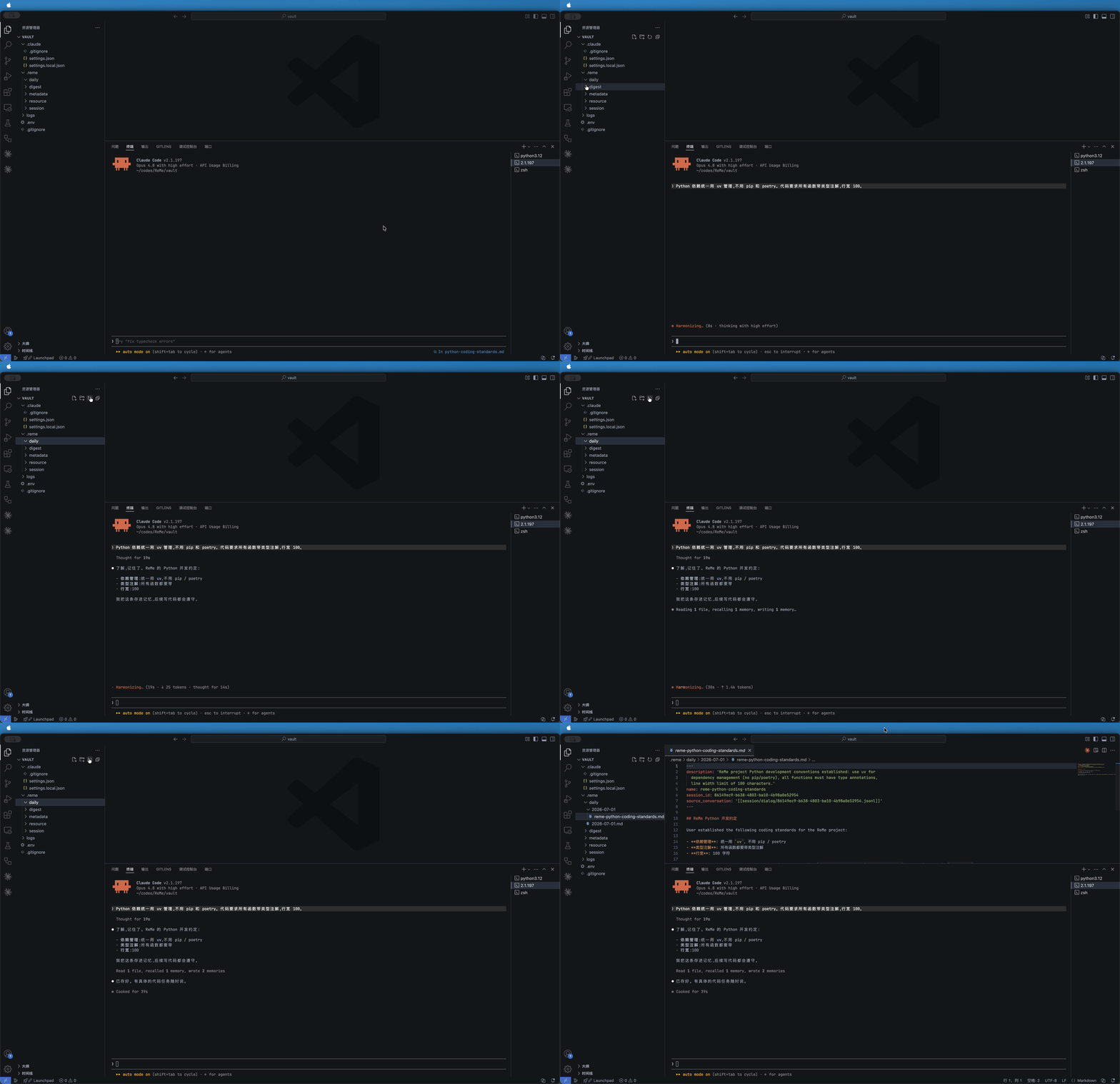
|

|
🛠️ ReMe Operations
ReMe operates the workspace through a unified job interface exposed by the CLI. Agents usually only need retrieval,
reading, writing, editing, and automatic memory commands. Lower-level indexing, frontmatter, and file operation commands
are mainly for maintenance, debugging, or advanced integration. Run reme help for the full job list.
| Command | Purpose |
|---|---|
reme start |
Start the local ReMe service. |
reme version / reme health_check |
Check package and component status. |
reme status |
Show stateful data-component memory estimates and process RSS. |
reme search |
Retrieve memory with BM25 and wikilinks by default, plus vectors when enabled. |
reme read / reme write / reme edit |
Inspect and maintain Markdown memory files. |
reme auto_memory |
Turn conversation messages into daily memory cards. Requires LLM credentials. |
reme auto_resource |
Interpret files under resource/ into daily resource cards. Requires LLM credentials. |
reme auto_dream / reme proactive |
Consolidate daily memory into long-term digest and surface topics worth attention. |
reme reindex |
Rebuild search and wikilink indexes from existing files. |
🤝 Community and Support
- Issues and requests: Check Open Issues first. If there is no related discussion, open a new issue with background, expected behavior, and impact scope.
- Code contributions: Before making changes, read the contribution guide. Source, schemas, and tests are the authoritative architecture and extension guide.
- Documentation contributions: Submit user-facing documentation changes to the
unified documentation repository under
reme/<version>/{en,zh}/. - Commit convention: Conventional Commits are recommended, for example
feat(search): add link expansion optionordocs(zh): update quick start. - Pre-submit checks: Before submitting a PR, try to run
pre-commit run --all-filesandpytest. If tests that depend on LLMs, embeddings, or external services cannot run, explain that in the PR. - Get help: Use GitHub Issues for bugs and feature requests. Project documentation is available at https://docs.agentscope.io/.
Contributors
Thanks to everyone who has contributed to ReMe:
📄 Citation
@software{ReMe2026,
  title = {Remember me, Refine me: Memory Management Kit for Agents},
  author = {ReMe Team},
  url = {https://reme.agentscope.io},
  year = {2026}
}
⚖️ License
This project is open source under the Apache License 2.0. See LICENSE for details.